
HPI
Case # 1. A 55-year-old patient with multiple cardiac risk factors presents with chest pressure, vomiting and sweats (i.e., a good story for ACS). ST-segment elevation is noted on the ECG.
List the criteria that define how true STEMI is diagnosed on the standard 12-lead ECG. [how many mm of STE, in which leads, etc.] (4 points)
Case # 1 Answer
- Use the J-point to determine the magnitude of ST-segment elevation relative to the isoelectric TP segment.
- J-point elevation in 2 contiguous leads > 1 mm is required in all leads (except V2/V3)
- Leads V2 and V3 limits are age and sex dependent
- In males < 40 years old, J-point elevation of as much as 2.5 mm in V2 and V3 can be a normal finding, but decreases with age
- Cutoff = ≥ 2.5 mm in V2 and V3 in men < 40 years
- In males ≥ 40 years old, J-point elevation as much as 2 mm in V2 and V3 can be a normal finding
- Cutoff = ≥ 2 mm in V2 and V3 in men ≥ 40 years
- J-point elevation in women is less than in men, elevation as much as 1.5 mm in V2 and V3 can be a normal finding.
- Cutoff = ≥ 1.5 mm in V2 and V3 in women
- In males < 40 years old, J-point elevation of as much as 2.5 mm in V2 and V3 can be a normal finding, but decreases with age
Pearl: Lesser degrees of ST displacement DO NOT exclude ischemia or evolving MI. A single ECG may miss dynamic changes, so do serial ECGs when in doubt!
Case # 2. Aside from the ST-segment elevation criteria listed above, there are a handful of other criteria for which immediate cath lab activation is indicated [i.e., even though ST-segment elevation in contiguous leads may be absent].
Please list those criteria. (5 points)
Case # 2 Answer
- Posterior STEMI
- LBBB with Sgarbossa
- Pacemaker with Sgarbossa
- De Winter T waves
- Non-STE ACS with intractable ischemia, hemodynamic or electrical instability, developing or worsening acute heart failure
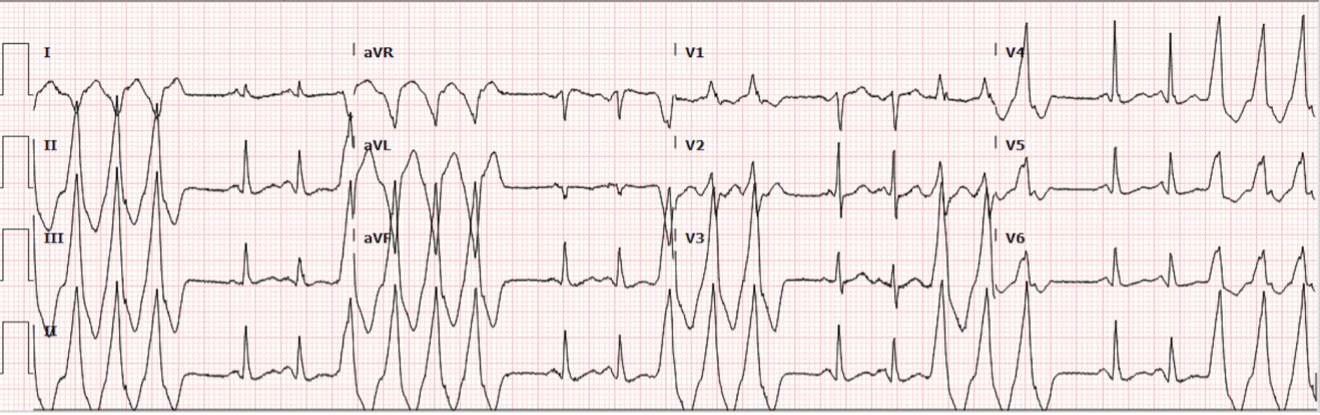
Case # 3. A 65-year-old man presents with palpitations. His blood pressure is 135/70. He is awake and alert. The ECG above is obtained.
What is the FULL ECG diagnosis?
What is the optimal management? (3 points)
Case # 3 Answer
Sinus tachycardia with runs of intermittent non-sustained ventricular tachycardia. Search for and treat the underlying conditions, beta blockers.
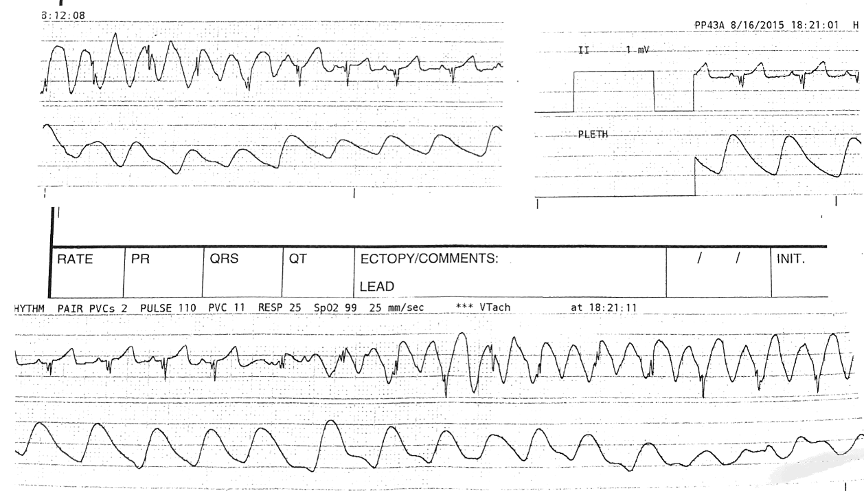
Case # 4. A 45-year-old woman was being evaluated at an urgent care center for a viral syndrome and while being monitored, developed the rhythm shown above. She was transferred to University Medical Center because of the findings on the strips. What is the diagnosis and management? (2 points)
Case # 4 Answer
Artifact, no treatment needed
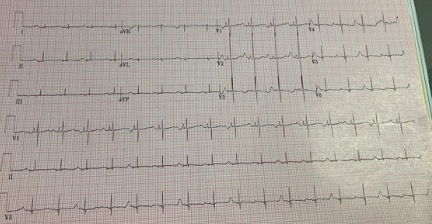
Case # 5. A 4-month-old male is brought to the ED because of persistent vomiting despite multiple doses of antiemetics, and at one point the parents thought that he was briefly unresponsive. The ECG shown above is obtained. What is the diagnosis and the likely cause of the unresponsiveness? (3 points)
Case # 5 Answer
Long QTc interval (T-wave alternans), torsades de pointes