
HPI
This week we review the answers to questions 10-14 from the 13th Annual UMEM Residency ECG Competition. Make sure to attempt to answer the questions yourself before watching the video or clicking the answer boxes in the summary section to reveal the answers and take home points!
Instructions from Dr. Mattu: In some of the following questions, I'll ask you for a FULL ECG interpretation/diagnosis. Here's what I am asking for:
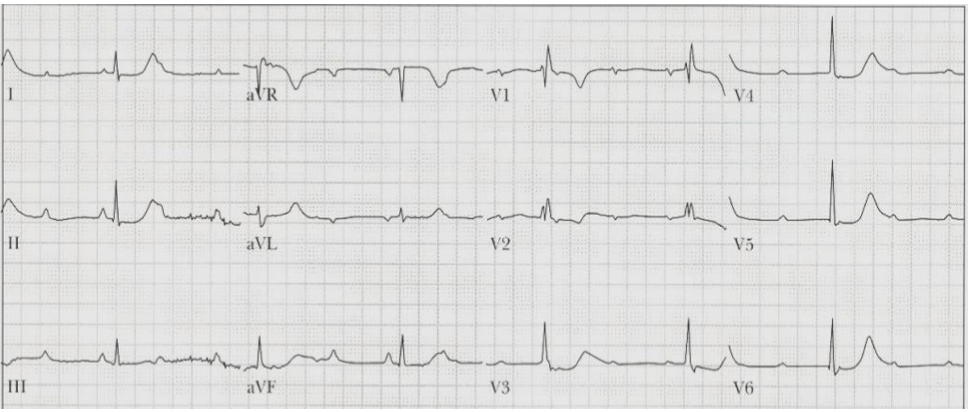
SAMPLE QUESTION: A 58 yo M presents with chest pain and the ECG noted below. What is the FULL ECG diagnosis? (5 points)
Sample Answer
Answer:
Sinus tachycardia, complete heart block, junctional escape rhythm, RBBB, diffuse ischemia
In this example, I would give you 1 point for identifying the atrial rhythm (ST), one point for identifying CHB, 1 point for identifying that there is a junctional escape, 1 point for identifying the RBBB, and one point for noting the ischemia (ST depression in multiple leads). In other words...be complete in your interpretation!
Be sure that you don't just describe what you see....interpret the ECG! For example, I don't want you to say "ST depression in __ leads." I want you to say "diffuse ischemia."
Also, in your interpretation, if you think there's an underlying issue, say it. For example, if you think the underlying dx is hyperK, or TCA OD, or Brugada, etc., say it.
Don't assume that points correlate with the number of things I am looking for. For example, if something is worth 3 points, that does NOT mean there are 3 things you need to list! Points are allotted based on how important I think something is.
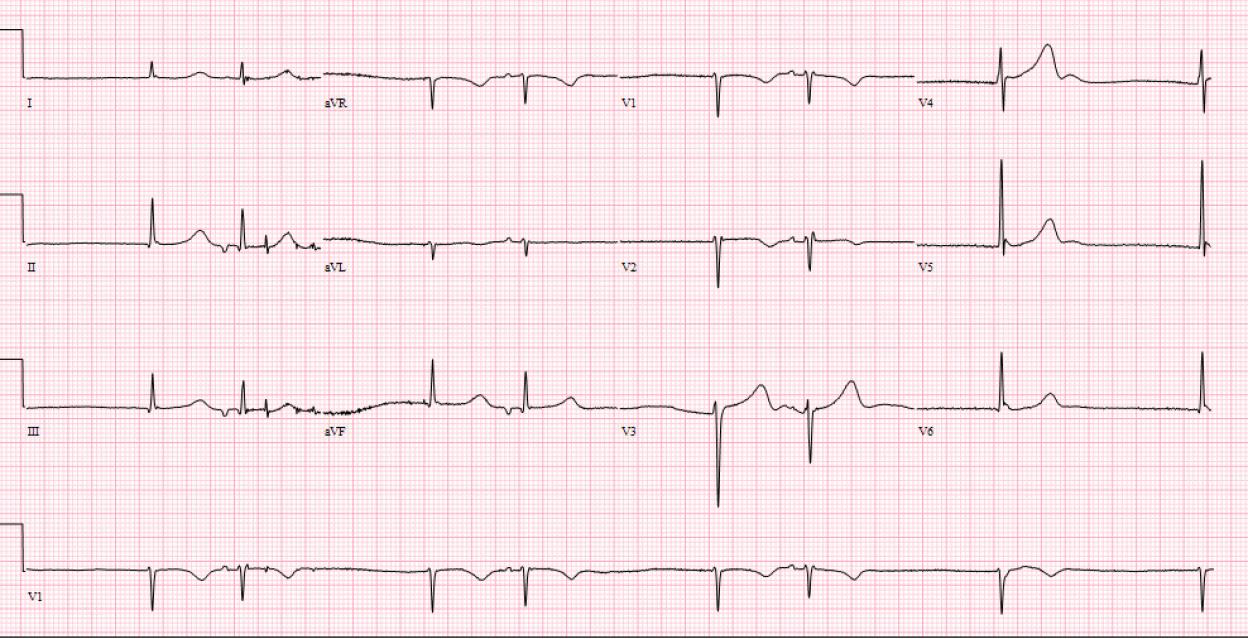
10. A 69 yo M presents with lightheadedness.
What is the FULL ECG diagnosis? (3 points)
Question # 10 Answer
- A simple description of the rhythm was accepted as a correct answer for this bonus question: atrial bradycardia with junctional escape beats that are followed by atrial captured beats…formal term is "(junctional) escape-capture bigeminy". See related ECG STAT post to learn more about this.
11. What is the Bix rule? (2 points)
Question # 11 Answer
-
Bix rule: when you see an atrial beat ½ way between two QRS complexes, suspect atrial flutter!
12. What is Ashman phenomenon? (2 points)
Question # 12 Answer
- Ashman phenomenon: aberrant conduction usually associated with rapid atrial fibrillation, typically causes a RBBB morphology.
13. Describe (or draw) what de Winter T waves are, in which leads you find them, and what they predict in the cath lab. (3 points)
Question # 13 Answer
- de Winter T waves: ST depression with hyperacute/tall symmetric T waves in the mid-precordial leads (V2, V3, V4) that occur during ACS Sx's, typically indicate an acute proximal LAD blockage; this is now an indication for immediate cath.
14. Describe the Aslanger pattern and what it predicts in the cath lab. (3 points)
Question # 14 Answer
- Aslanger pattern: STE in III but not the other inferior leads; ST is higher in V1 than V2; lateral STD with terminally-upright Ts; predicts acute left Cx or RCA blockage This is not yet an indication for immediate cath, but there is increasing literature suggesting that it probably should be.
Video
Keyboard shortcuts
- , / .
- Slower / faster by 0.1×
- Shift + , / .
- Slower / faster by 0.25×
- /
- Back to 1×
- Space or K
- Play / pause
- ← / →
- Back / forward 10s
- Shift + ← / →
- Back / forward 5s
- M
- Mute
Your speed is remembered for every video.