
HPI
This week we review the answers to the first 6 cases from the UMEM Residency ECG Competition. Make sure to attempt to answer the questions before clicking the red boxes to reveal answers and teaching pearls!
Case 1. A 56-year-old woman presents with N/V. What is the key finding on this ECG that leads to the diagnosis? Name one other condition that produces this same ECG finding?
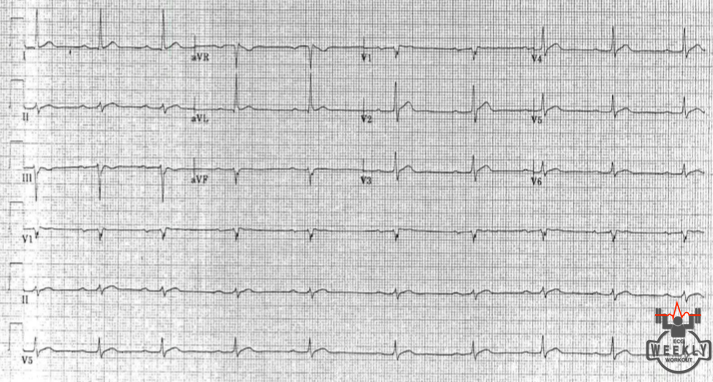
Short QT interval from hypercalcemia
Differential Diagnosis for a Short QT interval
- Hypercalcemia
- Digoxin toxicity
- Short QT syndrome
For more information about hypercalcemia and short QT intervals, review the case from Feb 2, 2015.
Case 2. A 45-year-old man presents with chest pain. What is your full ECG interpretation?
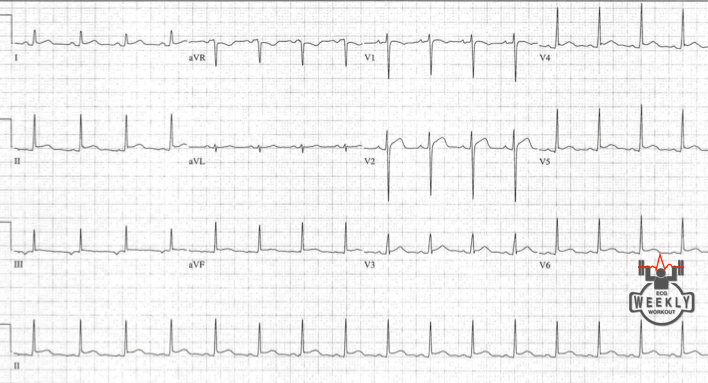
Ectopic atrial tachycardia, pericarditis (diffuse ST-segment elevation with concave morphology without any reciprocal changes)
- Remember that a normal sinus rhythm should have upright p-waves in all limb leads (inverted in aVR)
For more information about how to differentiate between STEMI vs. Pericarditis, review the case from Jan 26, 2015.
Case 3. A 56-year-old woman presents with N/V. What is the key finding on this ECG that leads to the diagnosis? Name one other condition that produces this same ECG finding?
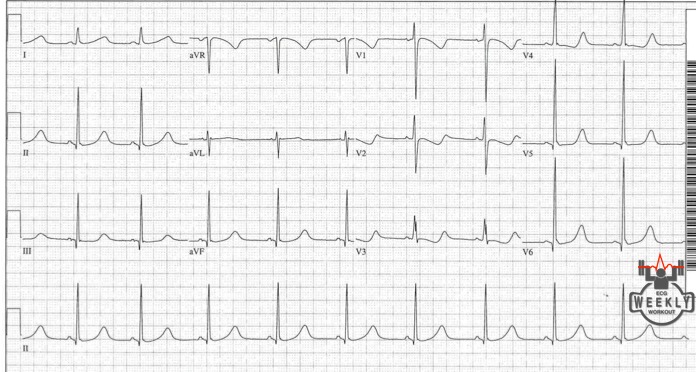
Severe hypokalemia
Case 4. A 56-year-old man presents with chest pain. What is your full ECG interpretation?
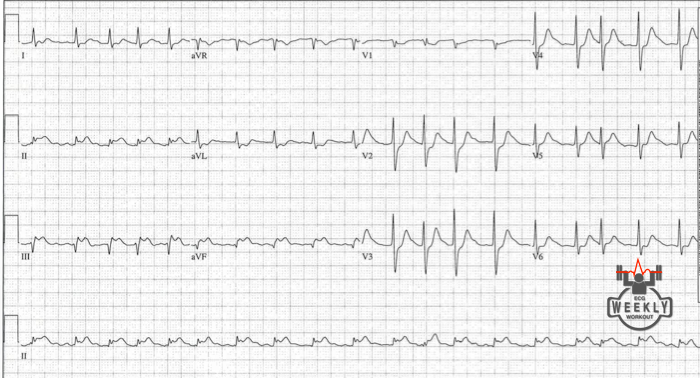
Acute inferior and posterior STEMI
Case 5. A 66-year-old man presents with decreased level of consciousness. What does this T-wave abnormality predict?
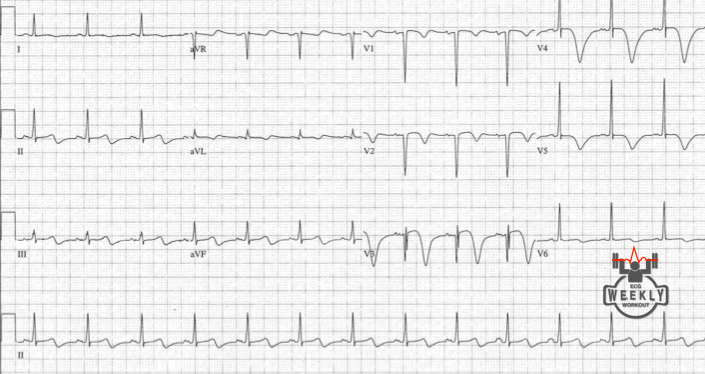
Elevated intracranial pressure, likely from an intracranial hemorrhage. Note the prolonged QT and deeply inverted T-waves. In patients with decreased level of consciousness and these ECG findings, consider causes of elevated ICP in your differential.
Case 6. A 45-year-old woman presents with palpitations. What is your full ECG interpretation?
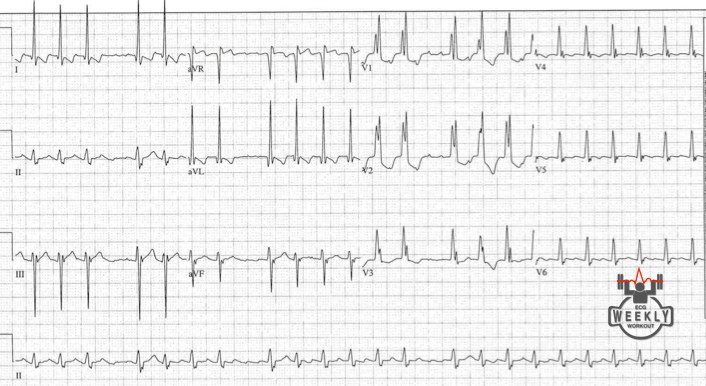
The best lead for picking up p-waves is V1! This is an example of atrial flutter with variable conduction. There is also a RBBB and leftward axis due to LVH (R wave > 11mm in aVL)