
Rhythm
Results:

Escape-Capture Bigeminy
Key Points: Definition: Escape-capture bigeminy is an uncommon rhythm in which escape beats alternate with conducted sinus capture beats, producing a repeating paired pattern. Mechanism: Sinus slowing, sinus pauses, or…
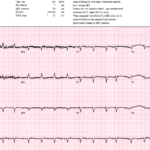
The Rhythm Behind the Irregularity
A 69-year-old woman presenting with sepsis gets the following ECG for tachycardia while febrile and shivering. The baseline is poor, atrial activity is difficult to identify, and the computer interpretation…
Sinus Bradycardia
Key Points: Definition: Sinus bradycardia is a sinus rhythm with a rate <60 bpm. In clinical practice, a rate <50 bpm is often a more useful threshold because resting rates…
Sinus Node Dysfunction (Sick Sinus Syndrome & Bradycardia-Tachycardia Syndrome)
Key Points: A spectrum, not a single rhythm: Sinus node dysfunction includes inappropriate sinus bradycardia, sinus pauses or arrest, SA exit block, chronotropic incompetence, and alternating atrial tachyarrhythmias with bradycardia….
Unstable Bradyarrhythmias
Key Points: Unstable bradyarrhythmias cause poor perfusion which can rapidly progress to shock, irreversible organ injury, or cardiac arrest. Priority: Do not treat the heart rate alone. Treat clinical instability….
Heart Rhythm: Basics
Key Points: Don’t trust the ECG machines automated interpretation. Confirm the rhythm yourself. Start with the ventricles (R–R pattern), then the atria (P waves), then the AV relationship (PR behavior/P:QRS)….
RR Interval: Basics
Key Points: The RR interval is the time between consecutive R waves. It is the most practical way to assess rate and regularity. RR is the backbone of rhythm interpretation:…
Ventricular Flutter (V-Flutter)
Key Points: Definition: A malignant ventricular tachyarrhythmia with a regular, sine-wave–like waveform at ~250–350 bpm, no isoelectric baseline, and no discernible P/QRS/T distinction. Clinical importance: Rapidly degenerates into ventricular fibrillation…
Irregularly Irregular Rhythm: Basics
Key Points: Definition: An irregularly irregular rhythm occurs when the R-R intervals or P-P intervals vary with no consistent pattern, making the rhythm unpredictable and abnormal. Clinical Significance: Identifying an…
Regularly Irregular Rhythm: Basics
Key Points: Definition: A regularly irregular rhythm occurs when the distance between R-R intervals or P-P intervals varies in a consistent, repeating pattern throughout the ECG tracing. Significance: Determining the…
Regular Rhythm: Basics
Key Points: Rhythm Regularity: Regular rhythm is characterized by equal distances between consecutive P waves (P-P intervals) and QRS complexes (R-R intervals). Verify rhythms with calipers—don’t trust the machine interpretation…
Heart Rate & Rhythm Interpretation
Key Points: Treat the patient, not just the number or rhythm. Start with a 10-second stability check. If the rhythm explains hypotension, shock, ischemic chest pain, altered mentation, or severe…
Sinus Arrhythmia
Key Points Definition: Phasic variation in sinus rate with respiration. P-P intervals shorten on inspiration and lengthen on expiration, producing a mild, patterned irregularity. Diagnostic threshold: Difference between the shortest…
Fusion Beats
Key Points Definition: A fusion beat occurs when two impulses — one from the normal conduction system (typically supraventricular) and one from an ectopic ventricular focus (e.g., during VT) —…
Ventricular Escape Rhythms
Key Points Wide QRS Complex Rhythm: Ventricular escape rhythms (aka idioventricular rhythms) are characterized by a wide QRS duration (>120 ms), absent or dissociated P-waves, and a regular, slow ventricular…
Sinus Tachycardia
Key Points Definition: Sinus tachycardia is a regular rhythm originating from the sinoatrial (SA) node, defined by a heart rate >100 bpm in adults or above age-adjusted norms in children….
Slow Atrial Fibrillation
Key Points Definition: Atrial fibrillation with a slow ventricular response, usually < 60 bpm. ECG: Irregularly irregular rhythm, no discrete P waves, slow R-R intervals. Common causes: AV-nodal blockers (digoxin,…

Rhythm Interpretation: Sutton’s rule for the best lead to evaluate atrial activity
A patient presents to the emergency department with palpitations and is found to have an irregular rhythm. The following ECG is obtained:

Narrow Complex Tachycardia: the maximum achievable sinus heart rate
A 67-year-old woman is brought to the ED by EMS for palpitations. She is found to have a heart rate ~168. Vital signs are otherwise within normal limits aside from…

Recurrent syncope with a short PR interval
A 48-year-old man presents with an episode of palpitations and near-syncope. He has had many similar episodes in the past without previous evaluation. Currently having mild palpitations with no other…
ECG Tags
- 5th Universal Definition of MI
- A-Z
- ACS Mimics
- ACS-OMI
- Activation
- Acute MI
- Advanced Level Curriculum
- Annual ECG Competition
- Anterior OMI
- Anterior STEMI
- Approach
- Arrest
- Arrhythmia
- Arrhythmogenic Cardiomyopathy
- Artifact
- ARVC
- ARVD
- Atrial Parasystole
- Attending
- AV Block
- aVF
- aVL
- aVR
- Axis
- Barcelona
- Basics
- Bix Rule
- Board Review
- Bradyarrhythmia
- Cath Lab
- Chest Pain
- Clumped Beats
- Competition
- Conduction
- Core
- Core Level Curriculum
- Critical ECG Patterns
- Curriculum
- DDx
- Delta
- Devices
- Diagonal Branch Occlusion
- Differential Diagnoses
- Diffuse ST Elevation
- Documentation
- Early Repolarization
- ECG Interpretation
- ECG Localization
- ECG Variant
- Education/Teaching
- Electrolytes
- Emergencies
- Emergent Cath Lab Activation
- EMS
- Expert Level Curriculum
- Flutter
- Flutter Waves
- Foundations Level Curriculum
- Guidelines
- High-Lateral STEMI
- Hub
- Hyperacute T waves
- Hypercalcemia
- Hyperkalemia
- Hypermagnesemia
- Hypocalcemia
- Hypokalemia
- Hypomagnesemia
- Hyponatremia
- Hypothermia
- I
- II
- Index
- Inferior OMI
- Inferior STEMI
- Intervals
- Irregular
- Ischemia
- Ischemia & Infarction
- J point
- J Waves
- JT
- Junctional Rhythm
- Juvenile T wave
- LAD Occlusion
- Lateral STEMI
- LBBB
- LCx Occlusion
- Lead Placement
- Left Atrial Enlargement (LAE)
- Life Savers
- LV an
- LV Aneurysm
- LVAD
- Mastery Level Curriculum
- Metabolic
- MI
- Mimics
- Morphology
- Narrow QRS
- Occlusion MI
- OMI Pattern
- Orthodromic AVRT
- Osborn Waves
- P Wave
- Paced Rhythms
- Pacemaker/ICD
- Paramedics
- Pauses
- PE
- Pediatrics
- Pericardial
- Pericarditis
- PGY-1
- PGY-2
- PGY-3
- PGY-4
- Post-Arrest
- post-arrest STEMI
- Post-Cardiac Arrest
- Posterior Extension
- Posterior MI
- Posterior STEMI
- potpourri
- PR
- Preexcitation
- Premature Complexes
- Prolonged QT
- Pulmonary Embolism
- Pulse-Tapping Artifact
- PVCs
- Q Wave
- QRS
- QT
- R Waves
- RAD
- Rate
- RBBB
- RCA Occlusion
- Regular
- Reperfusion
- Rhythm
- Right Atrial Enlargement (RAE)
- RR
- S Waves
- S1Q3T3
- Segments
- Seizure
- Serial ECGs
- Sgarbossa
- Shock
- South African Flag Sign
- ST
- ST Depression
- ST Elevation
- STEMI
- STEMI Equivalent
- STEMI Mimics
- STEMI Negative OMI
- Stepwise
- Stroke
- Structural
- Students
- SVT
- Syncope
- T Wave Inversion
- T Waves
- Tachyarrhythmia
- Tachycardia
- Tamponade
- Terminal QRS Distortion
- Toxicology
- TP
- Traditional STEMI Criteria
- U Waves
- Unstable
- V1-V4
- V2
- V5
- V6
- Vectors
- Ventricular Repolarization
- Ventricular Rhythms
- Ventricular Tachycardia
- Voltage
- Waveforms
- Wide QRS
- Workflow
- WPW
© 2026 ECG Weekly. All rights reserved. | Terms of Use | Privacy Policy
Powered by the member(dev) platform
 Loading...