
Approach
Results:
When a Seizure Isn’t a Seizure: Why Every First Seizure Needs an ECG
A 34-year-old woman presents after her third witnessed episode of generalized shaking. She has already been hospitalized, undergone an unrevealing workup, and started on levetiracetam. There is one unusual feature:…
UMMC Cases Part IV: Two Easily Missed ECG Diagnoses
A 73-year-old woman presents to the ED with palpitations and shortness of breath. Her ECG shows a regular narrow-complex tachycardia, and the computer interpretation is accepted by both the emergency…

The Bix Rule (Unmasking Atrial Flutter)
Key Points: Definition: The Bix rule is a bedside ECG clue suggesting that there may be twice as much atrial activity as is initially apparent. If an atrial deflection falls…
UMMC Cases Part II: Grouped Beats, Slow VT, and Diffuse ST Elevation
A 63-year-old man presents with shortness of breath. His ECG shows an unusual rhythm with repetitive groups of two beats separated by pauses.
Inverted P Waves in V1: DDx
Key Points: Know What Is Normal: The sinus P wave in V1 is often biphasic, with an initial positive and terminal negative component. A predominantly or completely negative P wave…
ECG Hallucinations: The Rhythms You See and the Rhythms You Miss
A patient presents with a regular narrow-complex tachycardia. The computerized interpretation identifies sinus tachycardia, and the rhythm appears superficially compatible with that diagnosis when lead II is reviewed. However, closer…
ECG Hallucinations: When Irregular Is Not Atrial Fibrillation
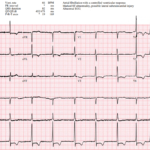
A 69-year-old man presents with chest pain. His ECG is interpreted by the computer as atrial fibrillation, a diagnosis that could significantly alter his evaluation and long-term management. The rhythm…
ECG Hallucinations: When S1Q3T3 Misleads
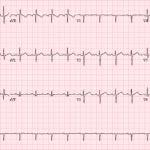
A 51-year-old truck driver presents to the ED after a brief syncopal episode at a rest stop. It is the middle of summer, his truck’s air conditioning is not working,…
The Rhythm Behind the Irregularity
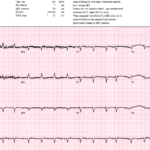
A 69-year-old woman presenting with sepsis gets the following ECG for tachycardia while febrile and shivering. The baseline is poor, atrial activity is difficult to identify, and the computer interpretation…
A Closer Look at the J Point
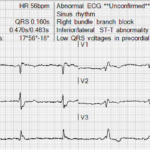
A 72-year-old man undergoes a prehospital 12-lead ECG. The tracing appears to show ST segment elevation in leads III, aVF, and aVR, raising concern for an inferior STEMI or high-risk…
Post-Arrest STEMI: Cath Lab or Caution?
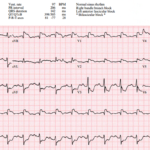
A 72-year-old man is brought to the ED after witnessed cardiac arrest. Bystander CPR was started quickly, EMS found a nonshockable rhythm, epinephrine was given, and ROSC was achieved. Forty…
J Point: Basics
Key Points: The J point is the junction between the end of the QRS complex and the beginning of the ST segment. It is a location, not a separate waveform….
A Post-Arrest ECG With a Dangerous New Bundle Branch Block
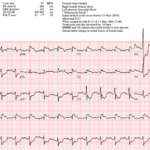
A 72-year-old man is brought to the ED after a witnessed out-of-hospital cardiac arrest. Bystander CPR is started quickly, EMS finds a non-shockable rhythm, and ROSC is achieved after one…
Wide QRS Complex: DDx
Key Points: A QRS duration greater than 120 ms reflects delayed or abnormal ventricular depolarization. A wide QRS may be chronic and benign in context, or it may be the…
UMEM Cases, Part 3: When the Diagnosis Seems Clear and When It Is Not
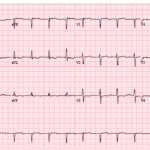
A 71-year-old man presents with shortness of breath, and his ECG is initially read as a junctional rhythm. On later review, it is even mistaken for atrial fibrillation. But the…
Junctional Rhythms
Key Points: Junctional rhythms arise from the AV junction, usually the AV node or proximal His bundle, when the sinus node slows, fails, or impulses do not reach the ventricles…
UMEM Cases, Part 2: When the ECG Conceals and When It Reveals
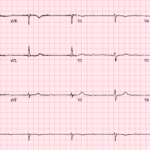
An 81-year-old woman presents with lightheadedness and marked bradycardia. Her ECG shows more P waves than QRS complexes, but the mechanism is not immediately clear. The key question is whether…
Heart Rhythm: Basics
Key Points: Don’t trust the ECG machines automated interpretation. Confirm the rhythm yourself. Start with the ventricles (R–R pattern), then the atria (P waves), then the AV relationship (PR behavior/P:QRS)….
Heart Rate: Basics
Key Points: Never accept the machine’s rate blindly. Confirm it yourself as ECG computer interpretations are frequently inaccurate. Verify paper speed and gain first (default 25 mm/s, 10 mm/mV). Name…
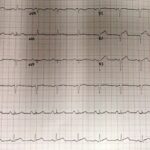
Subtle ST Abnormalities and a Difficult Cath Lab Decision
A 60-year-old man presents with chest pain that seems a little better after belching, but his clinician is not reassured. The initial ED ECG shows subtle ST-segment abnormalities, the computer…
ECG Tags
- 5th Universal Definition of MI
- A-Z
- ACS Mimics
- ACS-OMI
- Activation
- Acute MI
- Advanced Level Curriculum
- Annual ECG Competition
- Anterior OMI
- Anterior STEMI
- Approach
- Arrest
- Arrhythmia
- Arrhythmogenic Cardiomyopathy
- Artifact
- ARVC
- ARVD
- Atrial Parasystole
- Attending
- AV Block
- aVF
- aVL
- aVR
- Axis
- Barcelona
- Basics
- Bix Rule
- Board Review
- Bradyarrhythmia
- Cath Lab
- Chest Pain
- Clumped Beats
- Competition
- Conduction
- Core
- Core Level Curriculum
- Critical ECG Patterns
- Curriculum
- DDx
- Delta
- Devices
- Diagonal Branch Occlusion
- Differential Diagnoses
- Diffuse ST Elevation
- Documentation
- Early Repolarization
- ECG Interpretation
- ECG Localization
- ECG Variant
- Education/Teaching
- Electrolytes
- Emergencies
- Emergent Cath Lab Activation
- EMS
- Expert Level Curriculum
- Flutter
- Flutter Waves
- Foundations Level Curriculum
- Guidelines
- High-Lateral STEMI
- Hub
- Hyperacute T waves
- Hypercalcemia
- Hyperkalemia
- Hypermagnesemia
- Hypocalcemia
- Hypokalemia
- Hypomagnesemia
- Hyponatremia
- Hypothermia
- I
- II
- Index
- Inferior OMI
- Inferior STEMI
- Intervals
- Irregular
- Ischemia
- Ischemia & Infarction
- J point
- J Waves
- JT
- Junctional Rhythm
- Juvenile T wave
- LAD Occlusion
- Lateral STEMI
- LBBB
- LCx Occlusion
- Lead Placement
- Left Atrial Enlargement (LAE)
- Life Savers
- LV an
- LV Aneurysm
- LVAD
- Mastery Level Curriculum
- Metabolic
- MI
- Mimics
- Morphology
- Narrow QRS
- Occlusion MI
- OMI Pattern
- Orthodromic AVRT
- Osborn Waves
- P Wave
- Paced Rhythms
- Pacemaker/ICD
- Paramedics
- Pauses
- PE
- Pediatrics
- Pericardial
- Pericarditis
- PGY-1
- PGY-2
- PGY-3
- PGY-4
- Post-Arrest
- post-arrest STEMI
- Post-Cardiac Arrest
- Posterior Extension
- Posterior MI
- Posterior STEMI
- potpourri
- PR
- Preexcitation
- Premature Complexes
- Prolonged QT
- Pulmonary Embolism
- Pulse-Tapping Artifact
- PVCs
- Q Wave
- QRS
- QT
- R Waves
- RAD
- Rate
- RBBB
- RCA Occlusion
- Regular
- Reperfusion
- Rhythm
- Right Atrial Enlargement (RAE)
- RR
- S Waves
- S1Q3T3
- Segments
- Seizure
- Serial ECGs
- Sgarbossa
- Shock
- South African Flag Sign
- ST
- ST Depression
- ST Elevation
- STEMI
- STEMI Equivalent
- STEMI Mimics
- STEMI Negative OMI
- Stepwise
- Stroke
- Structural
- Students
- SVT
- Syncope
- T Wave Inversion
- T Waves
- Tachyarrhythmia
- Tachycardia
- Tamponade
- Terminal QRS Distortion
- Toxicology
- TP
- Traditional STEMI Criteria
- U Waves
- Unstable
- V1-V4
- V2
- V5
- V6
- Vectors
- Ventricular Repolarization
- Ventricular Rhythms
- Ventricular Tachycardia
- Voltage
- Waveforms
- Wide QRS
- Workflow
- WPW

© 2026 ECG Weekly. All rights reserved. | Terms of Use | Privacy Policy
Powered by the member(dev) platform
 Loading...