
Arrhythmia
Results:
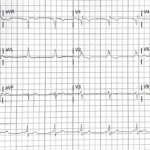
When a Seizure Isn’t a Seizure: Why Every First Seizure Needs an ECG
A 34-year-old woman presents after her third witnessed episode of generalized shaking. She has already been hospitalized, undergone an unrevealing workup, and started on levetiracetam. There is one unusual feature:…
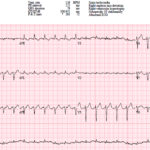
UMMC Cases Part IV: Two Easily Missed ECG Diagnoses
A 73-year-old woman presents to the ED with palpitations and shortness of breath. Her ECG shows a regular narrow-complex tachycardia, and the computer interpretation is accepted by both the emergency…

The Lewis Lead (Unmasking Atrial Activity)
Key Points: Purpose: The Lewis lead (modified S5 lead) is a modified ECG lead configuration designed to amplify atrial electrical activity, making P waves, flutter waves, and the relationship between…
The Bix Rule (Unmasking Atrial Flutter)
Key Points: Definition: The Bix rule is a bedside ECG clue suggesting that there may be twice as much atrial activity as is initially apparent. If an atrial deflection falls…
Monomorphic Ventricular Tachycardia (MMVT)
Key Points Definition: Monomorphic ventricular tachycardia is a ventricular rhythm with a wide QRS and a single, uniform QRS morphology throughout the run. Sustained VT: VT is sustained when it…
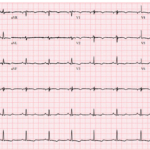
UMMC Cases Part III: When T Waves Help Tell the Story
A 23-year-old woman presents with palpitations and lightheadedness after a spontaneous episode of regular wide complex tachycardia. Her post-conversion ECG shows anterior T wave inversions with a subtle abnormality hiding…
Atrial Septal Defect (ASD) & Crochetage Pattern
Key Points: ASD Overview: Atrial septal defects are congenital communications between the atria. Significant defects may remain unrecognized into adulthood, eventually causing right-sided volume overload, pulmonary hypertension, atrial arrhythmias, exercise…
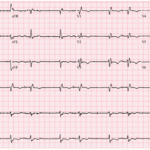
UMMC Cases Part II: Grouped Beats, Slow VT, and Diffuse ST Elevation
A 63-year-old man presents with shortness of breath. His ECG shows an unusual rhythm with repetitive groups of two beats separated by pauses.
Slow Ventricular Tachycardia (VT)
Key Points: Definition: Slow VT refers to ventricular tachycardia occurring at an unusually low ventricular rate, often near or even below the conventional tachycardia threshold. There is no universally accepted…
Ventricular Tachycardia (VT) Mimics
Key Points: Default assumption: A regular wide-complex tachycardia should be considered VT until another diagnosis is more likely. Rate modifies the differential, not the diagnosis. Typical monomorphic VT is often…
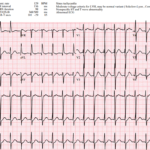
ECG Hallucinations: The Rhythms You See and the Rhythms You Miss
A patient presents with a regular narrow-complex tachycardia. The computerized interpretation identifies sinus tachycardia, and the rhythm appears superficially compatible with that diagnosis when lead II is reviewed. However, closer…
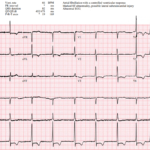
ECG Hallucinations: When Irregular Is Not Atrial Fibrillation
A 69-year-old man presents with chest pain. His ECG is interpreted by the computer as atrial fibrillation, a diagnosis that could significantly alter his evaluation and long-term management. The rhythm…
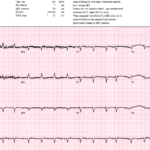
The Rhythm Behind the Irregularity
A 69-year-old woman presenting with sepsis gets the following ECG for tachycardia while febrile and shivering. The baseline is poor, atrial activity is difficult to identify, and the computer interpretation…
Atrial Fibrillation (AFib)
Key Points: Definition: Atrial fibrillation is a supraventricular arrhythmia characterized by disorganized atrial electrical activity, ineffective atrial contraction, and an irregular ventricular response. ECG diagnosis: Look for an irregularly irregular…
Atrial Flutter
Key Points: Atrial flutter is a supraventricular tachyarrhythmia caused by a macro-reentrant circuit, most commonly typical cavotricuspid isthmus-dependent flutter in the right atrium. The atrial rate is usually about 250-350…
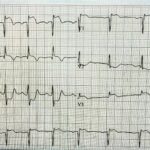
Three High Risk ECGs and the Right Next Move
A 34 year old man presents with acute chest pain radiating to the left arm associated with diaphoresis. He has hyperlipidemia and a family history of early coronary disease. The…
Brugada Syndrome (BrS)
Key Points: What It Is: Brugada syndrome is an inherited arrhythmogenic disorder associated with ventricular fibrillation (VF), polymorphic VT, and sudden cardiac death, often in patients without obvious structural heart…
T Wave Alternans
Key Points: T wave alternans is beat-to-beat alternation in T wave amplitude, polarity, or morphology with otherwise stable P waves and QRS complexes. Visible T wave alternans is a warning…
Sinus Node Dysfunction (Sick Sinus Syndrome & Bradycardia-Tachycardia Syndrome)
Key Points: A spectrum, not a single rhythm: Sinus node dysfunction includes inappropriate sinus bradycardia, sinus pauses or arrest, SA exit block, chronotropic incompetence, and alternating atrial tachyarrhythmias with bradycardia….
Sinus Arrest
Key Points: Definition: Sinus arrest occurs when the sinus node temporarily fails to generate an impulse. This produces an absence of the expected P wave and its associated QRS complex….
ECG Tags
- 5th Universal Definition of MI
- A-Z
- ACS Mimics
- ACS-OMI
- Activation
- Acute MI
- Advanced Level Curriculum
- Annual ECG Competition
- Anterior OMI
- Anterior STEMI
- Approach
- Arrest
- Arrhythmia
- Arrhythmogenic Cardiomyopathy
- Artifact
- ARVC
- ARVD
- Atrial Parasystole
- Attending
- AV Block
- aVF
- aVL
- aVR
- Axis
- Barcelona
- Basics
- Bix Rule
- Board Review
- Bradyarrhythmia
- Cath Lab
- Chest Pain
- Clumped Beats
- Competition
- Conduction
- Core
- Core Level Curriculum
- Critical ECG Patterns
- Curriculum
- DDx
- Delta
- Devices
- Diagonal Branch Occlusion
- Differential Diagnoses
- Diffuse ST Elevation
- Documentation
- Early Repolarization
- ECG Interpretation
- ECG Localization
- ECG Variant
- Education/Teaching
- Electrolytes
- Emergencies
- Emergent Cath Lab Activation
- EMS
- Expert Level Curriculum
- Flutter
- Flutter Waves
- Foundations Level Curriculum
- Guidelines
- High-Lateral STEMI
- Hub
- Hyperacute T waves
- Hypercalcemia
- Hyperkalemia
- Hypermagnesemia
- Hypocalcemia
- Hypokalemia
- Hypomagnesemia
- Hyponatremia
- Hypothermia
- I
- II
- Index
- Inferior OMI
- Inferior STEMI
- Intervals
- Irregular
- Ischemia
- Ischemia & Infarction
- J point
- J Waves
- JT
- Junctional Rhythm
- Juvenile T wave
- LAD Occlusion
- Lateral STEMI
- LBBB
- LCx Occlusion
- Lead Placement
- Left Atrial Enlargement (LAE)
- Life Savers
- LV an
- LV Aneurysm
- LVAD
- Mastery Level Curriculum
- Metabolic
- MI
- Mimics
- Morphology
- Narrow QRS
- Occlusion MI
- OMI Pattern
- Orthodromic AVRT
- Osborn Waves
- P Wave
- Paced Rhythms
- Pacemaker/ICD
- Paramedics
- Pauses
- PE
- Pediatrics
- Pericardial
- Pericarditis
- PGY-1
- PGY-2
- PGY-3
- PGY-4
- Post-Arrest
- post-arrest STEMI
- Post-Cardiac Arrest
- Posterior Extension
- Posterior MI
- Posterior STEMI
- potpourri
- PR
- Preexcitation
- Premature Complexes
- Prolonged QT
- Pulmonary Embolism
- Pulse-Tapping Artifact
- PVCs
- Q Wave
- QRS
- QT
- R Waves
- RAD
- Rate
- RBBB
- RCA Occlusion
- Regular
- Reperfusion
- Rhythm
- Right Atrial Enlargement (RAE)
- RR
- S Waves
- S1Q3T3
- Segments
- Seizure
- Serial ECGs
- Sgarbossa
- Shock
- South African Flag Sign
- ST
- ST Depression
- ST Elevation
- STEMI
- STEMI Equivalent
- STEMI Mimics
- STEMI Negative OMI
- Stepwise
- Stroke
- Structural
- Students
- SVT
- Syncope
- T Wave Inversion
- T Waves
- Tachyarrhythmia
- Tachycardia
- Tamponade
- Terminal QRS Distortion
- Toxicology
- TP
- Traditional STEMI Criteria
- U Waves
- Unstable
- V1-V4
- V2
- V5
- V6
- Vectors
- Ventricular Repolarization
- Ventricular Rhythms
- Ventricular Tachycardia
- Voltage
- Waveforms
- Wide QRS
- Workflow
- WPW
© 2026 ECG Weekly. All rights reserved. | Terms of Use | Privacy Policy
Powered by the member(dev) platform
 Loading...