
Conduction
Results:
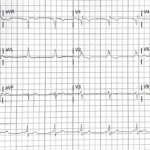
When a Seizure Isn’t a Seizure: Why Every First Seizure Needs an ECG
A 34-year-old woman presents after her third witnessed episode of generalized shaking. She has already been hospitalized, undergone an unrevealing workup, and started on levetiracetam. There is one unusual feature:…
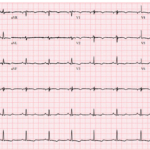
UMMC Cases Part III: When T Waves Help Tell the Story
A 23-year-old woman presents with palpitations and lightheadedness after a spontaneous episode of regular wide complex tachycardia. Her post-conversion ECG shows anterior T wave inversions with a subtle abnormality hiding…
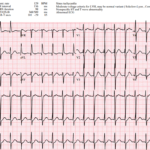
ECG Hallucinations: The Rhythms You See and the Rhythms You Miss
A patient presents with a regular narrow-complex tachycardia. The computerized interpretation identifies sinus tachycardia, and the rhythm appears superficially compatible with that diagnosis when lead II is reviewed. However, closer…
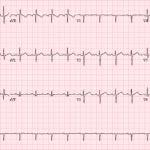
ECG Hallucinations: When S1Q3T3 Misleads
A 51-year-old truck driver presents to the ED after a brief syncopal episode at a rest stop. It is the middle of summer, his truck’s air conditioning is not working,…
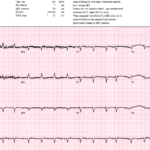
The Rhythm Behind the Irregularity
A 69-year-old woman presenting with sepsis gets the following ECG for tachycardia while febrile and shivering. The baseline is poor, atrial activity is difficult to identify, and the computer interpretation…

Not Enough P Waves (P:QRS < 1): DDx
Key Points: Fewer visible P waves than QRS complexes means some ventricular beats are not preceded by an identifiable sinus P wave. This usually reflects: Premature junctional or ventricular beats…
No Clear P Waves: DDx
Key Points: “No clear P waves” is an ECG finding, not a diagnosis. P waves may be truly absent, replaced by abnormal atrial activity, buried within the QRS or T…
Too Many P Waves (P:QRS>1): DDx
Key Points: More P waves than QRS complexes means that some atrial impulses are not activating the ventricles. The cause may be a premature atrial impulse that arrives while the…
Atrial Flutter
Key Points: Atrial flutter is a supraventricular tachyarrhythmia caused by a macro-reentrant circuit, most commonly typical cavotricuspid isthmus-dependent flutter in the right atrium. The atrial rate is usually about 250-350…
Occlusion MI in Left Bundle Branch Block (LBBB): STEMI Equivalent Pattern
Key Points: LBBB does not exclude acute coronary occlusion. LBBBs produce abnormal depolarization and expected secondary ST-T changes, which can mask or mimic ischemia. Acute occlusion MI can still be…
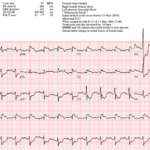
A Post-Arrest ECG With a Dangerous New Bundle Branch Block
A 72-year-old man is brought to the ED after a witnessed out-of-hospital cardiac arrest. Bystander CPR is started quickly, EMS finds a non-shockable rhythm, and ROSC is achieved after one…
Sinoatrial Exit Block
Key Points: Definition: Sinoatrial, or SA, exit block occurs when the sinus node generates an impulse that fails to conduct into the surrounding atrial tissue. The blocked impulse produces no…
Normal Cardiac Conduction
Key Points: Normal cardiac conduction begins in the SA node, travels through the atria to the AV node, then enters the His-Purkinje system to activate both ventricles rapidly and synchronously….
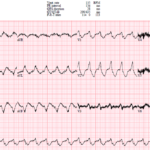
UMEM Cases, Part 4: When the Computer Misses the Rhythm and Flutter Fakes a STEMI
A 44-year-old man with severe cardiomyopathy, an LVAD, chronic amiodarone therapy, and an AICD presents with palpitations. His ECG shows a regular wide-complex tachycardia, but the rate is only 135….
Right Bundle Branch Block (RBBB)
Key Points: RBBB delays right ventricular activation. The left ventricle depolarizes normally through the left bundle, while the right ventricle is activated late by slow myocardial spread. ECG hallmark: QRS…
Left Bundle Branch Block (LBBB)
Key Points: LBBB delays left ventricular activation. The RV activates first through the intact right bundle, then the impulse spreads slowly from right to left across the septum and LV…
New RBBB + LAFB (Bifascicular Block) in ACS: OMI Pattern
Key Points: In a patient with ischemic symptoms, new RBBB + LAFB should raise concern for proximal LAD or septal ischemia until proven otherwise, especially if the patient has ongoing…
Junctional Tachycardia
Key Points: Junctional tachycardia is an uncommon supraventricular tachycardia arising from the AV junction, usually due to enhanced automaticity rather than reentry. It is usually a regular narrow-complex tachycardia, although…
Junctional Rhythms
Key Points: Junctional rhythms arise from the AV junction, usually the AV node or proximal His bundle, when the sinus node slows, fails, or impulses do not reach the ventricles…
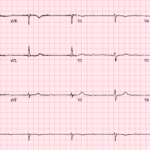
UMEM Cases, Part 2: When the ECG Conceals and When It Reveals
An 81-year-old woman presents with lightheadedness and marked bradycardia. Her ECG shows more P waves than QRS complexes, but the mechanism is not immediately clear. The key question is whether…
ECG Tags
- 5th Universal Definition of MI
- A-Z
- ACS Mimics
- ACS-OMI
- Activation
- Acute MI
- Advanced Level Curriculum
- Annual ECG Competition
- Anterior OMI
- Anterior STEMI
- Approach
- Arrest
- Arrhythmia
- Arrhythmogenic Cardiomyopathy
- Artifact
- ARVC
- ARVD
- Atrial Parasystole
- Attending
- AV Block
- aVF
- aVL
- aVR
- Axis
- Barcelona
- Basics
- Bix Rule
- Board Review
- Bradyarrhythmia
- Cath Lab
- Chest Pain
- Clumped Beats
- Competition
- Conduction
- Core
- Core Level Curriculum
- Critical ECG Patterns
- Curriculum
- DDx
- Delta
- Devices
- Diagonal Branch Occlusion
- Differential Diagnoses
- Diffuse ST Elevation
- Documentation
- Early Repolarization
- ECG Interpretation
- ECG Localization
- ECG Variant
- Education/Teaching
- Electrolytes
- Emergencies
- Emergent Cath Lab Activation
- EMS
- Expert Level Curriculum
- Flutter
- Flutter Waves
- Foundations Level Curriculum
- Guidelines
- High-Lateral STEMI
- Hub
- Hyperacute T waves
- Hypercalcemia
- Hyperkalemia
- Hypermagnesemia
- Hypocalcemia
- Hypokalemia
- Hypomagnesemia
- Hyponatremia
- Hypothermia
- I
- II
- Index
- Inferior OMI
- Inferior STEMI
- Intervals
- Irregular
- Ischemia
- Ischemia & Infarction
- J point
- J Waves
- JT
- Junctional Rhythm
- Juvenile T wave
- LAD Occlusion
- Lateral STEMI
- LBBB
- LCx Occlusion
- Lead Placement
- Left Atrial Enlargement (LAE)
- Life Savers
- LV an
- LV Aneurysm
- LVAD
- Mastery Level Curriculum
- Metabolic
- MI
- Mimics
- Morphology
- Narrow QRS
- Occlusion MI
- OMI Pattern
- Orthodromic AVRT
- Osborn Waves
- P Wave
- Paced Rhythms
- Pacemaker/ICD
- Paramedics
- Pauses
- PE
- Pediatrics
- Pericardial
- Pericarditis
- PGY-1
- PGY-2
- PGY-3
- PGY-4
- Post-Arrest
- post-arrest STEMI
- Post-Cardiac Arrest
- Posterior Extension
- Posterior MI
- Posterior STEMI
- potpourri
- PR
- Preexcitation
- Premature Complexes
- Prolonged QT
- Pulmonary Embolism
- Pulse-Tapping Artifact
- PVCs
- Q Wave
- QRS
- QT
- R Waves
- RAD
- Rate
- RBBB
- RCA Occlusion
- Regular
- Reperfusion
- Rhythm
- Right Atrial Enlargement (RAE)
- RR
- S Waves
- S1Q3T3
- Segments
- Seizure
- Serial ECGs
- Sgarbossa
- Shock
- South African Flag Sign
- ST
- ST Depression
- ST Elevation
- STEMI
- STEMI Equivalent
- STEMI Mimics
- STEMI Negative OMI
- Stepwise
- Stroke
- Structural
- Students
- SVT
- Syncope
- T Wave Inversion
- T Waves
- Tachyarrhythmia
- Tachycardia
- Tamponade
- Terminal QRS Distortion
- Toxicology
- TP
- Traditional STEMI Criteria
- U Waves
- Unstable
- V1-V4
- V2
- V5
- V6
- Vectors
- Ventricular Repolarization
- Ventricular Rhythms
- Ventricular Tachycardia
- Voltage
- Waveforms
- Wide QRS
- Workflow
- WPW
© 2026 ECG Weekly. All rights reserved. | Terms of Use | Privacy Policy
Powered by the member(dev) platform
 Loading...