
Emergencies
Results:
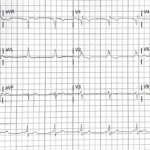
When a Seizure Isn’t a Seizure: Why Every First Seizure Needs an ECG
A 34-year-old woman presents after her third witnessed episode of generalized shaking. She has already been hospitalized, undergone an unrevealing workup, and started on levetiracetam. There is one unusual feature:…

Traditional STEMI Criteria
Key Points: STAT ECG Is the First Decision Point in Suspected ACS: The immediate purpose of the initial ECG is to identify acute coronary ischemia, particularly STEMI or another pattern…
Occlusion MI: STEMI & Beyond Hub
Key Points: The ECG’s Primary Role in ACS Is Detecting Acute Coronary Occlusion: Acute coronary occlusion is a time-critical diagnosis in which rapid recognition and reperfusion can preserve myocardium and…
EMS ECGs in Acute Coronary Syndromes (ACS)
Key Points: Get the ECG Early: Obtain and interpret a high-quality 12-lead ECG within 10 minutes of first medical contact (FMC) in patients with suspected ACS. Early prehospital ECG acquisition…
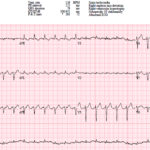
UMMC Cases Part IV: Two Easily Missed ECG Diagnoses
A 73-year-old woman presents to the ED with palpitations and shortness of breath. Her ECG shows a regular narrow-complex tachycardia, and the computer interpretation is accepted by both the emergency…
Must-Know Syncope: DDx
Key Points: Syncope and the ECG: Syncope is a transient loss of consciousness caused by transient global cerebral hypoperfusion, with rapid onset, brief duration, and spontaneous complete recovery. Cardiac syncope…
Monomorphic Ventricular Tachycardia (MMVT)
Key Points Definition: Monomorphic ventricular tachycardia is a ventricular rhythm with a wide QRS and a single, uniform QRS morphology throughout the run. Sustained VT: VT is sustained when it…
Syncope & “Seizure” Emergencies
Key Points: ECG Early: Obtain a 12-lead ECG early in patients with unexplained syncope or seizures. Patients with suspected cardiac or arrhythmic syncope should also receive continuous cardiac monitoring. Repeat…
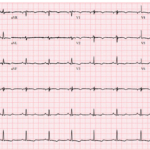
UMMC Cases Part III: When T Waves Help Tell the Story
A 23-year-old woman presents with palpitations and lightheadedness after a spontaneous episode of regular wide complex tachycardia. Her post-conversion ECG shows anterior T wave inversions with a subtle abnormality hiding…
Arrhythmogenic Cardiomyopathy (ACM)
Key Points: Definition: Arrhythmogenic cardiomyopathy (ACM), historically called arrhythmogenic right ventricular cardiomyopathy/dysplasia (ARVC/D), is an inherited myocardial disease characterized by progressive myocardial injury and fibrous replacement, with or without fatty…
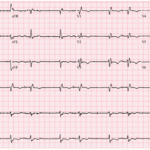
UMMC Cases Part II: Grouped Beats, Slow VT, and Diffuse ST Elevation
A 63-year-old man presents with shortness of breath. His ECG shows an unusual rhythm with repetitive groups of two beats separated by pauses.
Hypokalemia
Key Points: Hypokalemia delays ventricular repolarization, producing progressive changes in the T-U complex before serious arrhythmias develop. ECG progression: T-wave flattening → mild ST depression → prominent U waves →…
Hypokalemia Emergencies
Key Points: Severe hypokalemia can result in an arrhythmia emergency. The major threat is ventricular tachyarrhythmias, including torsades de pointes, polymorphic ventricular tachycardia, ventricular fibrillation, and sudden cardiac death. Severe…
Hypermagnesemia
Key Points: Hypermagnesemia is uncommon and usually occurs when impaired renal magnesium clearance is combined with increased magnesium exposure, such as magnesium-containing laxatives, antacids, bowel preparations, or therapeutic magnesium administration….
Hypomagnesemia
Key Points: Hypomagnesemia is an important arrhythmogenic electrolyte abnormality. It can promote atrial and ventricular ectopy and increase susceptibility to ventricular arrhythmias, particularly when other repolarization abnormalities are present. ECG…
Hypocalcemia
Key Points: ECG hallmark: QT prolongation caused predominantly by ST-segment prolongation, usually with relatively preserved T-wave morphology. Arrhythmia risk: Severe hypocalcemia can predispose to ventricular arrhythmias, including torsades de pointes…
Severe Hypothermia
Key Points: Severe hypothermia produces progressive electrical slowing. Sinus bradycardia, PR prolongation, QRS widening, QT prolongation, and atrial fibrillation with a slow ventricular response become increasingly common as core temperature…
Slow Ventricular Tachycardia (VT)
Key Points: Definition: Slow VT refers to ventricular tachycardia occurring at an unusually low ventricular rate, often near or even below the conventional tachycardia threshold. There is no universally accepted…
Ventricular Tachycardia (VT) Mimics
Key Points: Default assumption: A regular wide-complex tachycardia should be considered VT until another diagnosis is more likely. Rate modifies the differential, not the diagnosis. Typical monomorphic VT is often…
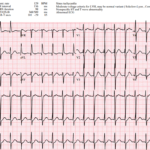
ECG Hallucinations: The Rhythms You See and the Rhythms You Miss
A patient presents with a regular narrow-complex tachycardia. The computerized interpretation identifies sinus tachycardia, and the rhythm appears superficially compatible with that diagnosis when lead II is reviewed. However, closer…
ECG Tags
- 5th Universal Definition of MI
- A-Z
- ACS Mimics
- ACS-OMI
- Activation
- Acute MI
- Advanced Level Curriculum
- Annual ECG Competition
- Anterior OMI
- Anterior STEMI
- Approach
- Arrest
- Arrhythmia
- Arrhythmogenic Cardiomyopathy
- Artifact
- ARVC
- ARVD
- Atrial Parasystole
- Attending
- AV Block
- aVF
- aVL
- aVR
- Axis
- Barcelona
- Basics
- Bix Rule
- Board Review
- Bradyarrhythmia
- Cath Lab
- Chest Pain
- Clumped Beats
- Competition
- Conduction
- Core
- Core Level Curriculum
- Critical ECG Patterns
- Curriculum
- DDx
- Delta
- Devices
- Diagonal Branch Occlusion
- Differential Diagnoses
- Diffuse ST Elevation
- Documentation
- Early Repolarization
- ECG Interpretation
- ECG Localization
- ECG Variant
- Education/Teaching
- Electrolytes
- Emergencies
- Emergent Cath Lab Activation
- EMS
- Expert Level Curriculum
- Flutter
- Flutter Waves
- Foundations Level Curriculum
- Guidelines
- High-Lateral STEMI
- Hub
- Hyperacute T waves
- Hypercalcemia
- Hyperkalemia
- Hypermagnesemia
- Hypocalcemia
- Hypokalemia
- Hypomagnesemia
- Hyponatremia
- Hypothermia
- I
- II
- Index
- Inferior OMI
- Inferior STEMI
- Intervals
- Irregular
- Ischemia
- Ischemia & Infarction
- J point
- J Waves
- JT
- Junctional Rhythm
- Juvenile T wave
- LAD Occlusion
- Lateral STEMI
- LBBB
- LCx Occlusion
- Lead Placement
- Left Atrial Enlargement (LAE)
- Life Savers
- LV an
- LV Aneurysm
- LVAD
- Mastery Level Curriculum
- Metabolic
- MI
- Mimics
- Morphology
- Narrow QRS
- Occlusion MI
- OMI Pattern
- Orthodromic AVRT
- Osborn Waves
- P Wave
- Paced Rhythms
- Pacemaker/ICD
- Paramedics
- Pauses
- PE
- Pediatrics
- Pericardial
- Pericarditis
- PGY-1
- PGY-2
- PGY-3
- PGY-4
- Post-Arrest
- post-arrest STEMI
- Post-Cardiac Arrest
- Posterior Extension
- Posterior MI
- Posterior STEMI
- potpourri
- PR
- Preexcitation
- Premature Complexes
- Prolonged QT
- Pulmonary Embolism
- Pulse-Tapping Artifact
- PVCs
- Q Wave
- QRS
- QT
- R Waves
- RAD
- Rate
- RBBB
- RCA Occlusion
- Regular
- Reperfusion
- Rhythm
- Right Atrial Enlargement (RAE)
- RR
- S Waves
- S1Q3T3
- Segments
- Seizure
- Serial ECGs
- Sgarbossa
- Shock
- South African Flag Sign
- ST
- ST Depression
- ST Elevation
- STEMI
- STEMI Equivalent
- STEMI Mimics
- STEMI Negative OMI
- Stepwise
- Stroke
- Structural
- Students
- SVT
- Syncope
- T Wave Inversion
- T Waves
- Tachyarrhythmia
- Tachycardia
- Tamponade
- Terminal QRS Distortion
- Toxicology
- TP
- Traditional STEMI Criteria
- U Waves
- Unstable
- V1-V4
- V2
- V5
- V6
- Vectors
- Ventricular Repolarization
- Ventricular Rhythms
- Ventricular Tachycardia
- Voltage
- Waveforms
- Wide QRS
- Workflow
- WPW
© 2026 ECG Weekly. All rights reserved. | Terms of Use | Privacy Policy
Powered by the member(dev) platform
 Loading...