
Emergencies
Results:

Polymorphic Ventricular Tachycardia (PMVT)
Key Points: Definition: Polymorphic ventricular tachycardia is VT with beat-to-beat variation in QRS morphology, axis, and amplitude. Clinical significance: PMVT is electrically unstable and can rapidly deteriorate into ventricular fibrillation…
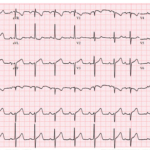
UMEM Cases, Part 1: When the ECG Lies and When It Evolves
A 72-year-old man presents with chest pain and shortness of breath. His ECG shows sinus rhythm with LVH, mild inferior ST elevation, and lateral ST-T abnormalities that some interpret as…
Nonsustained Ventricular Tachycardia (NSVT)
Key Points: Definition: Nonsustained ventricular tachycardia is 3 or more consecutive ventricular beats lasting less than 30 seconds and terminating spontaneously. Rate: VT is usually faster than 120 bpm, but…
STEMI vs Wide QRS (BBBs & Paced Rhythms): DDx
Key Points: Wide QRS rhythms distort repolarization. Bundle branch block and ventricular pacing create secondary ST-T changes even without occlusion MI. Appropriate discordance is expected. ST segments and T waves…
South African Flag Sign: OMI Pattern
Key Points: Pattern: The South African Flag sign is the combination of ST elevation in I, aVL, and V2 with reciprocal ST depression in III. It is a subtle but…
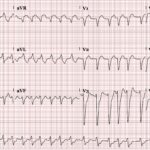
Three ECG Traps You Cannot Afford to Miss
A 60-year-old woman presents with palpitations and an irregular wide-complex tachycardia. The computer calls atrial fibrillation with a left bundle branch block, but a subtle clue in the precordial leads…
Occlusion MI in Ventricular Paced Rhythms: STEMI Equivalent Pattern
Key Points: Ventricular paced rhythms can mask acute coronary occlusion. Pacing alters depolarization and produces expected secondary ST-T abnormalities, so standard STEMI criteria are unreliable. Appropriate discordance is expected in…
The Life Savers: Critical ECGs Hub
Key Points: Life Savers are the can’t-miss ECGs. These patterns may reflect immediately life-threatening ischemic, electrical, mechanical, obstructive, toxicologic, or metabolic emergencies. This hub is built for rapid action. Use…
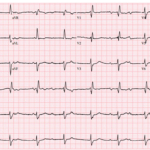
The Syncope ECG With Too Much P
A 68-year-old man has syncope, then has a second syncopal episode while lying still on a stretcher during evaluation at an outpatient clinic. He is sent emergently to the ED….
Electrical Alternans
Key Points: Electrical alternans is a beat-to-beat alternation in QRS amplitude, axis, or both. It is classically associated with a large pericardial effusion and may support concern for tamponade, but…
Pericardial Effusion
Key Points: Pericardial effusion is the accumulation of fluid in the pericardial sac. ECG may provide clues, but it is not sensitive enough to exclude effusion. Important ECG clues include…
STEMI vs LVH: DDx
Key Points: Left ventricular hypertrophy (LVH) with strain is one of the most common and dangerous STEMI mimics, particularly in the anterior leads, and is a frequent cause of false-positive…
Pericardial Tamponade
Key Points: Pericardial tamponade is a hemodynamic diagnosis, not just an ECG diagnosis. ECG may show sinus tachycardia, low-voltage QRS, and sometimes electrical alternans, but none are sensitive enough to…
Modified Sgarbossa Criteria: STEMI Equivalent Pattern
Key Points: LBBB and ventricular-paced rhythms can hide acute coronary occlusion because abnormal depolarization creates expected secondary ST-T changes. Occlusion MI can still be recognized when those ST changes are…

Preexcitation Pitfalls (Part 4): Potpourri Cases & Final Teaching Points
A 49-year-old man arrives with palpitations and chest discomfort. The monitor shows an irregular, wide-complex tachycardia with varying morphology and rates nearing 250 to 300 bpm. The team debates polymorphic…
Isorhythmic AV Dissociation
Key Points: Isorhythmic AV dissociation is a form of AV dissociation in which the sinus rate and junctional or ventricular escape rate are nearly identical, making the P waves and…
Third-Degree AV Block (Complete Heart Block)
Key Points: Third-degree AV block is complete failure of atrial impulses to conduct to the ventricles. The defining ECG feature is AV dissociation with no conducted P waves. The atrial…
Second-Degree AV Block Type I (Mobitz I/Wenckebach)
Key Points: Mobitz I is defined by progressive PR prolongation until a single P wave fails to conduct, after which the cycle resets. The block is usually at the AV…
Second-Degree AV Block with 2:1 Conduction
Key Points: Second-degree AV block with 2:1 conduction means every other P wave conducts and every other P wave is blocked. A single ECG with 2:1 conduction usually cannot be…
Second-Degree AV Block Type II (Mobitz II)
Key Points: Mobitz II is defined by sudden failure of AV conduction after at least 2 consecutive conducted beats with fixed PR intervals and no preceding PR prolongation. The block…
ECG Tags
- 5th Universal Definition of MI
- A-Z
- ACS Mimics
- ACS-OMI
- Activation
- Acute MI
- Advanced Level Curriculum
- Annual ECG Competition
- Anterior OMI
- Anterior STEMI
- Approach
- Arrest
- Arrhythmia
- Arrhythmogenic Cardiomyopathy
- Artifact
- ARVC
- ARVD
- Atrial Parasystole
- Attending
- AV Block
- aVF
- aVL
- aVR
- Axis
- Barcelona
- Basics
- Bix Rule
- Board Review
- Bradyarrhythmia
- Cath Lab
- Chest Pain
- Clumped Beats
- Competition
- Conduction
- Core
- Core Level Curriculum
- Critical ECG Patterns
- Curriculum
- DDx
- Delta
- Devices
- Diagonal Branch Occlusion
- Differential Diagnoses
- Diffuse ST Elevation
- Documentation
- Early Repolarization
- ECG Interpretation
- ECG Localization
- ECG Variant
- Education/Teaching
- Electrolytes
- Emergencies
- Emergent Cath Lab Activation
- EMS
- Expert Level Curriculum
- Flutter
- Flutter Waves
- Foundations Level Curriculum
- Guidelines
- High-Lateral STEMI
- Hub
- Hyperacute T waves
- Hypercalcemia
- Hyperkalemia
- Hypermagnesemia
- Hypocalcemia
- Hypokalemia
- Hypomagnesemia
- Hyponatremia
- Hypothermia
- I
- II
- Index
- Inferior OMI
- Inferior STEMI
- Intervals
- Irregular
- Ischemia
- Ischemia & Infarction
- J point
- J Waves
- JT
- Junctional Rhythm
- Juvenile T wave
- LAD Occlusion
- Lateral STEMI
- LBBB
- LCx Occlusion
- Lead Placement
- Left Atrial Enlargement (LAE)
- Life Savers
- LV an
- LV Aneurysm
- LVAD
- Mastery Level Curriculum
- Metabolic
- MI
- Mimics
- Morphology
- Narrow QRS
- Occlusion MI
- OMI Pattern
- Orthodromic AVRT
- Osborn Waves
- P Wave
- Paced Rhythms
- Pacemaker/ICD
- Paramedics
- Pauses
- PE
- Pediatrics
- Pericardial
- Pericarditis
- PGY-1
- PGY-2
- PGY-3
- PGY-4
- Post-Arrest
- post-arrest STEMI
- Post-Cardiac Arrest
- Posterior Extension
- Posterior MI
- Posterior STEMI
- potpourri
- PR
- Preexcitation
- Premature Complexes
- Prolonged QT
- Pulmonary Embolism
- Pulse-Tapping Artifact
- PVCs
- Q Wave
- QRS
- QT
- R Waves
- RAD
- Rate
- RBBB
- RCA Occlusion
- Regular
- Reperfusion
- Rhythm
- Right Atrial Enlargement (RAE)
- RR
- S Waves
- S1Q3T3
- Segments
- Seizure
- Serial ECGs
- Sgarbossa
- Shock
- South African Flag Sign
- ST
- ST Depression
- ST Elevation
- STEMI
- STEMI Equivalent
- STEMI Mimics
- STEMI Negative OMI
- Stepwise
- Stroke
- Structural
- Students
- SVT
- Syncope
- T Wave Inversion
- T Waves
- Tachyarrhythmia
- Tachycardia
- Tamponade
- Terminal QRS Distortion
- Toxicology
- TP
- Traditional STEMI Criteria
- U Waves
- Unstable
- V1-V4
- V2
- V5
- V6
- Vectors
- Ventricular Repolarization
- Ventricular Rhythms
- Ventricular Tachycardia
- Voltage
- Waveforms
- Wide QRS
- Workflow
- WPW
© 2026 ECG Weekly. All rights reserved. | Terms of Use | Privacy Policy
Powered by the member(dev) platform
 Loading...