
Arrhythmia
Results:
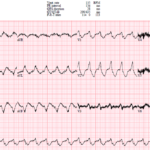
UMEM Cases, Part 4: When the Computer Misses the Rhythm and Flutter Fakes a STEMI
A 44-year-old man with severe cardiomyopathy, an LVAD, chronic amiodarone therapy, and an AICD presents with palpitations. His ECG shows a regular wide-complex tachycardia, but the rate is only 135….
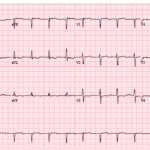
UMEM Cases, Part 3: When the Diagnosis Seems Clear and When It Is Not
A 71-year-old man presents with shortness of breath, and his ECG is initially read as a junctional rhythm. On later review, it is even mistaken for atrial fibrillation. But the…

Junctional Tachycardia
Key Points: Junctional tachycardia is an uncommon supraventricular tachycardia arising from the AV junction, usually due to enhanced automaticity rather than reentry. It is usually a regular narrow-complex tachycardia, although…
Dysrhythmias in LVAD Patients
Key Points: Continuous-flow LVADs can mask cardiovascular collapse. Patients may remain awake during sustained VT or even VF because the pump can provide temporary flow. Treat the rhythm and the…
Unstable Bradyarrhythmias
Key Points: Unstable bradyarrhythmias cause poor perfusion which can rapidly progress to shock, irreversible organ injury, or cardiac arrest. Priority: Do not treat the heart rate alone. Treat clinical instability….
Junctional Rhythms
Key Points: Junctional rhythms arise from the AV junction, usually the AV node or proximal His bundle, when the sinus node slows, fails, or impulses do not reach the ventricles…
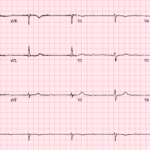
UMEM Cases, Part 2: When the ECG Conceals and When It Reveals
An 81-year-old woman presents with lightheadedness and marked bradycardia. Her ECG shows more P waves than QRS complexes, but the mechanism is not immediately clear. The key question is whether…
Supraventricular Tachycardias (SVTs)
Key Points: SVT in bedside emergency medicine usually refers to a rapid regular tachycardia arising above the ventricles, most commonly AVNRT, AVRT, or atrial tachycardia. Most SVTs are regular narrow-complex…
Polymorphic Ventricular Tachycardia (PMVT)
Key Points: Definition: Polymorphic ventricular tachycardia is VT with beat-to-beat variation in QRS morphology, axis, and amplitude. Clinical significance: PMVT is electrically unstable and can rapidly deteriorate into ventricular fibrillation…
Nonsustained Ventricular Tachycardia (NSVT)
Key Points: Definition: Nonsustained ventricular tachycardia is 3 or more consecutive ventricular beats lasting less than 30 seconds and terminating spontaneously. Rate: VT is usually faster than 120 bpm, but…
Occlusion MI in Ventricular Paced Rhythms: STEMI Equivalent Pattern
Key Points: Ventricular paced rhythms can mask acute coronary occlusion. Pacing alters depolarization and produces expected secondary ST-T abnormalities, so standard STEMI criteria are unreliable. Appropriate discordance is expected in…

Preexcitation Pitfalls (Part 4): Potpourri Cases & Final Teaching Points
A 49-year-old man arrives with palpitations and chest discomfort. The monitor shows an irregular, wide-complex tachycardia with varying morphology and rates nearing 250 to 300 bpm. The team debates polymorphic…
Atrial Flutter with Variable Conduction
Key Points: Mechanism: Typical atrial flutter arises from a large re-entry circuit in the right atrium. The atrial rate is usually near 300 beats per minute. ECG hallmark: Continuous “saw-tooth”…
Atrial Flutter 2:1 Conduction
Key Points: Atrial flutter is a macro-reentrant atrial tachycardia, most commonly typical cavotricuspid isthmus-dependent right atrial flutter, with an atrial rate usually near 300 bpm. With 2:1 AV conduction, the…
Atrial Flutter 1:1 Conduction
Key Points: Rare, high-risk rhythm. Atrial flutter with 1:1 conduction can produce ventricular rates of 240-320 bpm and may rapidly cause hypotension, ischemia, or collapse. Often mimics VT. The QRS…
Flutter Waves (F waves): Basics
Key Points: Flutter waves are caused by a macro-reentrant atrial circuit, most often typical right atrial flutter. Atrial rate is usually ~250-350 bpm, classically near 300 bpm. ECG shows continuous…
Wolff-Parkinson White (WPW) Syndrome
Key Points: Pattern vs syndrome: WPW pattern is ECG evidence of pre-excitation without symptoms. WPW syndrome is pattern plus symptomatic tachyarrhythmia (palpitations, syncope, “seizure”, aborted sudden cardiac arrest). PR interval…
WPW Syndrome and Pseudo-MI Patterns
Key Points: WPW alters ventricular depolarization, producing secondary repolarization abnormalities that can mimic or mask myocardial infarction. ST-segment deviation in WPW is often non-ischemic, driven by abnormal activation via the…
Atrial Fibrillation with WPW (Pre-excited AF)
Key Points: Pre-excited AF is the most dangerous WPW rhythm. It can deteriorate quickly to VF because the accessory pathway may conduct atrial impulses to the ventricle at extreme rates….
WPW with Antidromic SVT (Antidromic AVRT)
Key Points: Antidromic AVRT is an AV re-entrant tachycardia that conducts antegrade down the accessory pathway and returns retrograde through the AV node (or another pathway), producing a regular wide-complex…
ECG Tags
- 5th Universal Definition of MI
- A-Z
- ACS Mimics
- ACS-OMI
- Activation
- Acute MI
- Advanced Level Curriculum
- Annual ECG Competition
- Anterior OMI
- Anterior STEMI
- Approach
- Arrest
- Arrhythmia
- Arrhythmogenic Cardiomyopathy
- Artifact
- ARVC
- ARVD
- Atrial Parasystole
- Attending
- AV Block
- aVF
- aVL
- aVR
- Axis
- Barcelona
- Basics
- Bix Rule
- Board Review
- Bradyarrhythmia
- Cath Lab
- Chest Pain
- Clumped Beats
- Competition
- Conduction
- Core
- Core Level Curriculum
- Critical ECG Patterns
- Curriculum
- DDx
- Delta
- Devices
- Diagonal Branch Occlusion
- Differential Diagnoses
- Diffuse ST Elevation
- Documentation
- Early Repolarization
- ECG Interpretation
- ECG Localization
- ECG Variant
- Education/Teaching
- Electrolytes
- Emergencies
- Emergent Cath Lab Activation
- EMS
- Expert Level Curriculum
- Flutter
- Flutter Waves
- Foundations Level Curriculum
- Guidelines
- High-Lateral STEMI
- Hub
- Hyperacute T waves
- Hypercalcemia
- Hyperkalemia
- Hypermagnesemia
- Hypocalcemia
- Hypokalemia
- Hypomagnesemia
- Hyponatremia
- Hypothermia
- I
- II
- Index
- Inferior OMI
- Inferior STEMI
- Intervals
- Irregular
- Ischemia
- Ischemia & Infarction
- J point
- J Waves
- JT
- Junctional Rhythm
- Juvenile T wave
- LAD Occlusion
- Lateral STEMI
- LBBB
- LCx Occlusion
- Lead Placement
- Left Atrial Enlargement (LAE)
- Life Savers
- LV an
- LV Aneurysm
- LVAD
- Mastery Level Curriculum
- Metabolic
- MI
- Mimics
- Morphology
- Narrow QRS
- Occlusion MI
- OMI Pattern
- Orthodromic AVRT
- Osborn Waves
- P Wave
- Paced Rhythms
- Pacemaker/ICD
- Paramedics
- Pauses
- PE
- Pediatrics
- Pericardial
- Pericarditis
- PGY-1
- PGY-2
- PGY-3
- PGY-4
- Post-Arrest
- post-arrest STEMI
- Post-Cardiac Arrest
- Posterior Extension
- Posterior MI
- Posterior STEMI
- potpourri
- PR
- Preexcitation
- Premature Complexes
- Prolonged QT
- Pulmonary Embolism
- Pulse-Tapping Artifact
- PVCs
- Q Wave
- QRS
- QT
- R Waves
- RAD
- Rate
- RBBB
- RCA Occlusion
- Regular
- Reperfusion
- Rhythm
- Right Atrial Enlargement (RAE)
- RR
- S Waves
- S1Q3T3
- Segments
- Seizure
- Serial ECGs
- Sgarbossa
- Shock
- South African Flag Sign
- ST
- ST Depression
- ST Elevation
- STEMI
- STEMI Equivalent
- STEMI Mimics
- STEMI Negative OMI
- Stepwise
- Stroke
- Structural
- Students
- SVT
- Syncope
- T Wave Inversion
- T Waves
- Tachyarrhythmia
- Tachycardia
- Tamponade
- Terminal QRS Distortion
- Toxicology
- TP
- Traditional STEMI Criteria
- U Waves
- Unstable
- V1-V4
- V2
- V5
- V6
- Vectors
- Ventricular Repolarization
- Ventricular Rhythms
- Ventricular Tachycardia
- Voltage
- Waveforms
- Wide QRS
- Workflow
- WPW
© 2026 ECG Weekly. All rights reserved. | Terms of Use | Privacy Policy
Powered by the member(dev) platform
 Loading...