
Core
Results:

Post-Cardiac Arrest ECGs Hub
Key Points: The first post-ROSC ECG is essential but imperfect. Obtain it immediately, but interpret it in context. Global ischemia, defibrillation, acidosis, hypothermia, vasopressors, artifact, and severe metabolic derangements can…
Post-Arrest STEMI: Cath Lab Decisions
Key Points: Persistent ST elevation after ROSC remains a guideline-supported indication for emergency coronary angiography. The 2025 ACC/AHA/ACEP/NAEMSP/SCAI ACS guideline recommends emergency angiography for patients after cardiac arrest with suspected…
Post-Arrest No STEMI: When Cath Can Wait
Key Points: Stable post-arrest patients without ST elevation should not go to reflex immediate cath solely because cardiac arrest occurred. Randomized trials in OHCA patients without ST elevation have not…
Pediatric ECG in Cardiac Arrest
Key Points: Pediatric arrest is usually respiratory, hypoxic, or shock-related, not primary coronary occlusion. The ECG still matters because it can reveal reversible metabolic, toxicologic, structural, inflammatory, or inherited electrical…
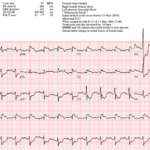
A Post-Arrest ECG With a Dangerous New Bundle Branch Block
A 72-year-old man is brought to the ED after a witnessed out-of-hospital cardiac arrest. Bystander CPR is started quickly, EMS finds a non-shockable rhythm, and ROSC is achieved after one…
ECG Learning Resources & Recommendations
Key Points: ECG STAT is designed for point-of-care review, but ECG mastery requires repeated exposure, active interpretation, feedback, assessment, and clinical correlation. Use the ECG Skills curriculum tracks as your…
Recommended Online ECG Resources
Key Points: Online ECG resources are best used for repeated case exposure, quick review, and pattern reinforcement. They should complement, not replace, a structured ECG curriculum. ECG STAT is designed…
Sinoatrial Exit Block
Key Points: Definition: Sinoatrial, or SA, exit block occurs when the sinus node generates an impulse that fails to conduct into the surrounding atrial tissue. The blocked impulse produces no…
Sinus Arrest
Key Points: Definition: Sinus arrest occurs when the sinus node temporarily fails to generate an impulse. This produces an absence of the expected P wave and its associated QRS complex….
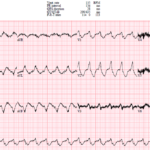
UMEM Cases, Part 4: When the Computer Misses the Rhythm and Flutter Fakes a STEMI
A 44-year-old man with severe cardiomyopathy, an LVAD, chronic amiodarone therapy, and an AICD presents with palpitations. His ECG shows a regular wide-complex tachycardia, but the rate is only 135….
Right Bundle Branch Block (RBBB)
Key Points: RBBB delays right ventricular activation. The left ventricle depolarizes normally through the left bundle, while the right ventricle is activated late by slow myocardial spread. ECG hallmark: QRS…
New RBBB + LAFB (Bifascicular Block) in ACS: OMI Pattern
Key Points: In a patient with ischemic symptoms, new RBBB + LAFB should raise concern for proximal LAD or septal ischemia until proven otherwise, especially if the patient has ongoing…
Wide QRS Complex: DDx
Key Points: A QRS duration greater than 120 ms reflects delayed or abnormal ventricular depolarization. A wide QRS may be chronic and benign in context, or it may be the…
QT Interval: Basics
Key Points: Definition: The QT interval is measured from the onset of the QRS complex to the end of the T wave. It represents the total duration of ventricular depolarization…
Junctional Tachycardia
Key Points: Junctional tachycardia is an uncommon supraventricular tachycardia arising from the AV junction, usually due to enhanced automaticity rather than reentry. It is usually a regular narrow-complex tachycardia, although…
Dysrhythmias in LVAD Patients
Key Points: Continuous-flow LVADs can mask cardiovascular collapse. Patients may remain awake during sustained VT or even VF because the pump can provide temporary flow. Treat the rhythm and the…
Torsade de Pointes (TdP)
Key Points: Definition: Torsade de pointes is a specific form of polymorphic ventricular tachycardia (PMVT) occurring in the setting of prolonged ventricular repolarization/QT prolongation. ECG Pattern: TdP shows beat-to-beat variation…
Prolonged QT Interval: DDx
Key Points: What the QT Represents: The QT interval extends from the onset of the QRS to the end of the T wave and represents the total duration of ventricular…
Pediatric ECG Red Flags
Key Points: Any wide QRS (>90 ms) in an infant or small child is abnormal and should trigger evaluation for VT, sodium-channel blockade, or conduction disease. QTc >450 ms in…
Unstable Bradyarrhythmias
Key Points: Unstable bradyarrhythmias cause poor perfusion which can rapidly progress to shock, irreversible organ injury, or cardiac arrest. Priority: Do not treat the heart rate alone. Treat clinical instability….
ECG Tags
- 5th Universal Definition of MI
- A-Z
- ACS Mimics
- ACS-OMI
- Activation
- Acute MI
- Advanced Level Curriculum
- Annual ECG Competition
- Anterior OMI
- Anterior STEMI
- Approach
- Arrest
- Arrhythmia
- Arrhythmogenic Cardiomyopathy
- Artifact
- ARVC
- ARVD
- Atrial Parasystole
- Attending
- AV Block
- aVF
- aVL
- aVR
- Axis
- Barcelona
- Basics
- Bix Rule
- Board Review
- Bradyarrhythmia
- Cath Lab
- Chest Pain
- Clumped Beats
- Competition
- Conduction
- Core
- Core Level Curriculum
- Critical ECG Patterns
- Curriculum
- DDx
- Delta
- Devices
- Diagonal Branch Occlusion
- Differential Diagnoses
- Diffuse ST Elevation
- Documentation
- Early Repolarization
- ECG Interpretation
- ECG Localization
- ECG Variant
- Education/Teaching
- Electrolytes
- Emergencies
- Emergent Cath Lab Activation
- EMS
- Expert Level Curriculum
- Flutter
- Flutter Waves
- Foundations Level Curriculum
- Guidelines
- High-Lateral STEMI
- Hub
- Hyperacute T waves
- Hypercalcemia
- Hyperkalemia
- Hypermagnesemia
- Hypocalcemia
- Hypokalemia
- Hypomagnesemia
- Hyponatremia
- Hypothermia
- I
- II
- Index
- Inferior OMI
- Inferior STEMI
- Intervals
- Irregular
- Ischemia
- Ischemia & Infarction
- J point
- J Waves
- JT
- Junctional Rhythm
- Juvenile T wave
- LAD Occlusion
- Lateral STEMI
- LBBB
- LCx Occlusion
- Lead Placement
- Left Atrial Enlargement (LAE)
- Life Savers
- LV an
- LV Aneurysm
- LVAD
- Mastery Level Curriculum
- Metabolic
- MI
- Mimics
- Morphology
- Narrow QRS
- Occlusion MI
- OMI Pattern
- Orthodromic AVRT
- Osborn Waves
- P Wave
- Paced Rhythms
- Pacemaker/ICD
- Paramedics
- Pauses
- PE
- Pediatrics
- Pericardial
- Pericarditis
- PGY-1
- PGY-2
- PGY-3
- PGY-4
- Post-Arrest
- post-arrest STEMI
- Post-Cardiac Arrest
- Posterior Extension
- Posterior MI
- Posterior STEMI
- potpourri
- PR
- Preexcitation
- Premature Complexes
- Prolonged QT
- Pulmonary Embolism
- Pulse-Tapping Artifact
- PVCs
- Q Wave
- QRS
- QT
- R Waves
- RAD
- Rate
- RBBB
- RCA Occlusion
- Regular
- Reperfusion
- Rhythm
- Right Atrial Enlargement (RAE)
- RR
- S Waves
- S1Q3T3
- Segments
- Seizure
- Serial ECGs
- Sgarbossa
- Shock
- South African Flag Sign
- ST
- ST Depression
- ST Elevation
- STEMI
- STEMI Equivalent
- STEMI Mimics
- STEMI Negative OMI
- Stepwise
- Stroke
- Structural
- Students
- SVT
- Syncope
- T Wave Inversion
- T Waves
- Tachyarrhythmia
- Tachycardia
- Tamponade
- Terminal QRS Distortion
- Toxicology
- TP
- Traditional STEMI Criteria
- U Waves
- Unstable
- V1-V4
- V2
- V5
- V6
- Vectors
- Ventricular Repolarization
- Ventricular Rhythms
- Ventricular Tachycardia
- Voltage
- Waveforms
- Wide QRS
- Workflow
- WPW
© 2026 ECG Weekly. All rights reserved. | Terms of Use | Privacy Policy
Powered by the member(dev) platform
 Loading...