
ACS-OMI
Results:
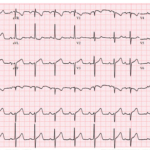
UMEM Cases, Part 1: When the ECG Lies and When It Evolves
A 72-year-old man presents with chest pain and shortness of breath. His ECG shows sinus rhythm with LVH, mild inferior ST elevation, and lateral ST-T abnormalities that some interpret as…
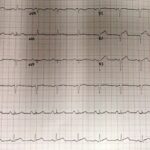
Subtle ST Abnormalities and a Difficult Cath Lab Decision
A 60-year-old man presents with chest pain that seems a little better after belching, but his clinician is not reassured. The initial ED ECG shows subtle ST-segment abnormalities, the computer…

STEMI vs Wide QRS (BBBs & Paced Rhythms): DDx
Key Points: Wide QRS rhythms distort repolarization. Bundle branch block and ventricular pacing create secondary ST-T changes even without occlusion MI. Appropriate discordance is expected. ST segments and T waves…
South African Flag Sign: OMI Pattern
Key Points: Pattern: The South African Flag sign is the combination of ST elevation in I, aVL, and V2 with reciprocal ST depression in III. It is a subtle but…
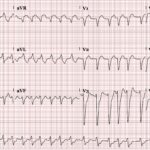
Three ECG Traps You Cannot Afford to Miss
A 60-year-old woman presents with palpitations and an irregular wide-complex tachycardia. The computer calls atrial fibrillation with a left bundle branch block, but a subtle clue in the precordial leads…
Occlusion MI in Ventricular Paced Rhythms: STEMI Equivalent Pattern
Key Points: Ventricular paced rhythms can mask acute coronary occlusion. Pacing alters depolarization and produces expected secondary ST-T abnormalities, so standard STEMI criteria are unreliable. Appropriate discordance is expected in…
STEMI vs LVH: DDx
Key Points: Left ventricular hypertrophy (LVH) with strain is one of the most common and dangerous STEMI mimics, particularly in the anterior leads, and is a frequent cause of false-positive…
Modified Sgarbossa Criteria: STEMI Equivalent Pattern
Key Points: LBBB and ventricular-paced rhythms can hide acute coronary occlusion because abnormal depolarization creates expected secondary ST-T changes. Occlusion MI can still be recognized when those ST changes are…
Appropriate Discordance
Key Points: Appropriate discordance refers to the expected secondary ST segment and T wave pattern seen with abnormal ventricular depolarization, especially LBBB and ventricular-paced rhythm. The ST segment and T…
WPW Syndrome and Pseudo-MI Patterns
Key Points: WPW alters ventricular depolarization, producing secondary repolarization abnormalities that can mimic or mask myocardial infarction. ST-segment deviation in WPW is often non-ischemic, driven by abnormal activation via the…
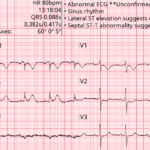
Baltimore City EMS ECGs: Pitfalls and Mimics (Part 1)
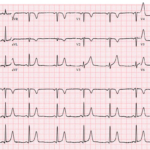
A 68-year-old man is brought to the emergency department by EMS with acute chest discomfort. The following prehospital ECG was obtained and shows concave ST elevation across multiple leads. The…
Four ECG Pitfalls That Punish Anchoring Bias
A 43-year-old woman with sharp left-sided chest pain and minimal cardiac risk factors has an initial ECG that is not diagnostic for STEMI. She looks stable, but one feature on…
STEMI (-) Occlusion MI: OMI Patterns
Key Points: Traditional STEMI criteria miss many acute coronary occlusions. A substantial proportion of true OMIs do not meet classic millimetric STEMI thresholds. OMI is a pathophysiologic diagnosis, not an…
STEMI in the Presence of Baseline ECG Abnormalities
Key Points: Baseline ECG abnormalities do not protect patients from occlusion MI. They increase miss rates because they distort the ST segment and T waves. The core question is not…
Lateral and High-Lateral STEMI: Criteria, Localization, and Pitfalls
Key Points: Lateral and high-lateral STEMI often present with subtle ST elevation and are commonly missed or labeled as nonspecific ST-T changes. Small-appearing ECG changes may represent true coronary occlusion…
Inferior STEMI: Criteria, RV Involvement, and Pitfalls
Key Points: Inferior STEMI is the most common STEMI subtype and is frequently complicated by right ventricular and posterior involvement. Inferior occlusion may present with classic ST elevation, subtle ischemic…
Anterior STEMI: Criteria, Localization, and Pitfalls
Key Points: Anterior STEMI represents large myocardial territory at risk and carries the highest mortality among STEMI subtypes. Early recognition and reperfusion are critical. LAD occlusion may present with classic…
ECG Findings of LV Aneurysm
Key Points: Definition: A true LV aneurysm is a chronic, post transmural MI complication from scarred myocardium with akinetic or dyskinetic (paradoxical) wall motion. ECG hallmark: Persistent ST elevation in…
ST Elevation: DDx
Key Points: ST elevation describes an ECG finding, not a diagnosis. It reflects abnormal ventricular repolarization and can arise from ischemic, structural, metabolic, electrical, or extracardiac processes. Occlusion MI is…
Posterior STEMI: Criteria & Pitfalls
Key Points: High risk of missed diagnosis. Isolated posterior occlusion MI is frequently missed because ST elevation is absent on the standard 12-lead ECG. Instead, posterior infarction most often presents…
ECG Tags
- 5th Universal Definition of MI
- A-Z
- ACS Mimics
- ACS-OMI
- Activation
- Acute MI
- Advanced Level Curriculum
- Annual ECG Competition
- Anterior OMI
- Anterior STEMI
- Approach
- Arrest
- Arrhythmia
- Arrhythmogenic Cardiomyopathy
- Artifact
- ARVC
- ARVD
- Atrial Parasystole
- Attending
- AV Block
- aVF
- aVL
- aVR
- Axis
- Barcelona
- Basics
- Bix Rule
- Board Review
- Bradyarrhythmia
- Cath Lab
- Chest Pain
- Clumped Beats
- Competition
- Conduction
- Core
- Core Level Curriculum
- Critical ECG Patterns
- Curriculum
- DDx
- Delta
- Devices
- Diagonal Branch Occlusion
- Differential Diagnoses
- Diffuse ST Elevation
- Documentation
- Early Repolarization
- ECG Interpretation
- ECG Localization
- ECG Variant
- Education/Teaching
- Electrolytes
- Emergencies
- Emergent Cath Lab Activation
- EMS
- Expert Level Curriculum
- Flutter
- Flutter Waves
- Foundations Level Curriculum
- Guidelines
- High-Lateral STEMI
- Hub
- Hyperacute T waves
- Hypercalcemia
- Hyperkalemia
- Hypermagnesemia
- Hypocalcemia
- Hypokalemia
- Hypomagnesemia
- Hyponatremia
- Hypothermia
- I
- II
- Index
- Inferior OMI
- Inferior STEMI
- Intervals
- Irregular
- Ischemia
- Ischemia & Infarction
- J point
- J Waves
- JT
- Junctional Rhythm
- Juvenile T wave
- LAD Occlusion
- Lateral STEMI
- LBBB
- LCx Occlusion
- Lead Placement
- Left Atrial Enlargement (LAE)
- Life Savers
- LV an
- LV Aneurysm
- LVAD
- Mastery Level Curriculum
- Metabolic
- MI
- Mimics
- Morphology
- Narrow QRS
- Occlusion MI
- OMI Pattern
- Orthodromic AVRT
- Osborn Waves
- P Wave
- Paced Rhythms
- Pacemaker/ICD
- Paramedics
- Pauses
- PE
- Pediatrics
- Pericardial
- Pericarditis
- PGY-1
- PGY-2
- PGY-3
- PGY-4
- Post-Arrest
- post-arrest STEMI
- Post-Cardiac Arrest
- Posterior Extension
- Posterior MI
- Posterior STEMI
- potpourri
- PR
- Preexcitation
- Premature Complexes
- Prolonged QT
- Pulmonary Embolism
- Pulse-Tapping Artifact
- PVCs
- Q Wave
- QRS
- QT
- R Waves
- RAD
- Rate
- RBBB
- RCA Occlusion
- Regular
- Reperfusion
- Rhythm
- Right Atrial Enlargement (RAE)
- RR
- S Waves
- S1Q3T3
- Segments
- Seizure
- Serial ECGs
- Sgarbossa
- Shock
- South African Flag Sign
- ST
- ST Depression
- ST Elevation
- STEMI
- STEMI Equivalent
- STEMI Mimics
- STEMI Negative OMI
- Stepwise
- Stroke
- Structural
- Students
- SVT
- Syncope
- T Wave Inversion
- T Waves
- Tachyarrhythmia
- Tachycardia
- Tamponade
- Terminal QRS Distortion
- Toxicology
- TP
- Traditional STEMI Criteria
- U Waves
- Unstable
- V1-V4
- V2
- V5
- V6
- Vectors
- Ventricular Repolarization
- Ventricular Rhythms
- Ventricular Tachycardia
- Voltage
- Waveforms
- Wide QRS
- Workflow
- WPW
© 2026 ECG Weekly. All rights reserved. | Terms of Use | Privacy Policy
Powered by the member(dev) platform
 Loading...