
Metabolic
Results:
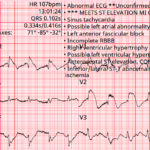
Baltimore City EMS ECGs: Pitfalls and Mimics (Part 2)
A 54-year-old man presents to the emergency department by EMS with acute shortness of breath. A prehospital ECG triggers a STEMI alert based on the computer interpretation. The tracing shows…

Short QT Interval: DDx
Key Points: Short QT Interval: A QT interval is considered short when the corrected QT (QTc) interval is less than 350 ms. A short QT interval on the ECG can…
Hypocalcemia
Key Points: Prolonged QTc is the hallmark ECG change in hypocalcemia, driven mainly by ST-segment prolongation with relatively normal T-wave shape. Hypocalcemia can increase arrhythmia risk, including TdP, but TdP…
Hypercalcemia
Key Points: Shortened QTc interval is the hallmark ECG clue in hypercalcemia, primarily due to a shortened ST segment duration. Hypercalcemia can mimic acute STEMI on ECG (pseudoinfarction pattern due…
Hyperkalemia Emergencies
Key Points: Severe Hyperkalemia Mimics Several Life-Threatening Conditions: Severe hyperkalemia is one of the most dangerous ECG mimics in emergency medicine. It can resemble unstable bradyarrhythmias, VT, STEMI, and pacemaker…
STEMI vs Severe Hyperkalemia: DDx
Key Points: Severe hyperkalemia is a true ECG chameleon. It can produce ST elevation, wide QRS complexes, axis shifts, and conduction blocks that closely mimic STEMI or ventricular tachycardia. New…
Hypomagnesemia
Key Points: Hypomagnesemia is an important arrhythmogenic electrolyte abnormality. It increases risk of atrial and ventricular ectopy, ventricular tachycardia, and torsades de pointes, especially when QT is prolonged. The most…
Himalayan T Waves
Key Points Tall, broad-based T–U fusion that looks like a mountain peak, usually from severe hypokalemia; think high torsades risk until proven otherwise. Hallmark is prolonged repolarization: QT appears long…
Ventricular Tachycardia (VT) Mimics
Key Points: Initial Assumption: Any wide (QRS >120 ms), regular tachycardia should be considered ventricular tachycardia (VT) until clearly proven otherwise. VT Characteristics: VT generally has a ventricular rate of…
Osborn (J) Wave: Basics
Key Points An Osborn wave is a notch or slur at the J point that becomes more prominent as core temperature falls. Most visible in inferolateral and precordial leads; can…
Severe Hypothermia
Key Points Severe hypothermia causes rate- and temperature-dependent ECG changes that signal high arrhythmia risk. Recognition guides safe rewarming and prevents iatrogenic VF. Osborn (J) waves may appear and typically…
BRASH Syndrome
Key Points BRASH is a synergistic spiral: bradycardia, renal failure, therapeutic AV-nodal blockade, shock, and hyperkalemia. The signature clue is disproportionate brady-shock despite only modest potassium elevation. Do not be…
Hypermagnesemia
Key Points: Hypermagnesemia is usually seen in the setting of renal impairment or excessive magnesium exposure, including laxatives, antacids, bowel preps, or therapeutic magnesium infusion. The key ECG concern is…
U Wave: Basics
Key Points Definition and origin: The U wave is a small deflection following the T wave, best seen in V2–V3. It likely reflects late ventricular repolarization or Purkinje repolarization. Normal…
Metabolic Emergencies
Key Points A Simple Yet Powerful Tool: With just a piece of paper and some ink, the ECG can be the earliest clue to life-threatening metabolic disease when labs are…
Altered Mental Status Emergencies
Key Points Always get a 12-lead ECG in altered or confused patients. The ECG is a great triage and risk stratification tool and can reveal reversible, life-threatening causes when history…
Hypokalemia
Key Points: Hypokalemia slows ventricular repolarization and alters the T–U complex before it triggers arrhythmias. Progressive pattern: T-wave flattening → prominent U waves → T–U fusion with apparent QT prolongation;…
Hypokalemia Emergencies
Key Points Severe hypokalemia can produce dramatic ECG changes that may be mistaken for acute coronary syndromes. It can also precipitate life-threatening arrhythmias, including torsades de pointes and ventricular tachyarrhythmias…
Hyperkalemic Periodic Paralysis (Impressive Syndrome)
Key Points What It Is: A rare autosomal dominant sodium channelopathy that leads to episodic muscle weakness or paralysis in the setting of elevated serum potassium. Named after “Impressive,” the…
Hypokalemic Periodic Paralysis
Key Points Definition: A rare ion channelopathy that causes sudden, reversible episodes of symmetric flaccid paralysis triggered by low serum potassium. It may be inherited or secondary to thyrotoxicosis or…
ECG Tags
- A-Z
- ACS Mimics
- ACS-OMI
- Activation
- Advanced Level Curriculum
- Annual ECG Competition
- Anterior OMI
- Anterior STEMI
- Approach
- Arrest
- Arrhythmia
- Arrhythmogenic Cardiomyopathy
- Artifact
- ARVC
- ARVD
- Atrial Parasystole
- Attending
- AV Block
- aVF
- aVL
- aVR
- Axis
- Basics
- Board Review
- Bradyarrhythmia
- Chest Pain
- Clumped Beats
- Conduction
- Core
- Core Level Curriculum
- Critical ECG Patterns
- Curriculum
- DDx
- Delta
- Devices
- Diagonal Branch Occlusion
- Differential Diagnoses
- Diffuse ST Elevation
- Documentation
- Early Repolarization
- ECG Interpretation
- ECG Localization
- ECG Variant
- Education/Teaching
- Electrolytes
- Emergencies
- Emergent Cath Lab Activation
- EMS
- Expert Level Curriculum
- Foundations Level Curriculum
- Guidelines
- High-Lateral STEMI
- Hub
- Hyperacute T waves
- Hypercalcemia
- Hyperkalemia
- Hypermagnesemia
- Hypocalcemia
- Hypokalemia
- Hypomagnesemia
- Hyponatremia
- Hypothermia
- I
- II
- Index
- Inferior OMI
- Inferior STEMI
- Intervals
- Irregular
- Ischemia
- Ischemia & Infarction
- J Waves
- JT
- Juvenile T wave
- LAD Occlusion
- Lateral STEMI
- LBBB
- LCx Occlusion
- Lead Placement
- Life Savers
- LV an
- LV Aneurysm
- Mastery Level Curriculum
- Metabolic
- Mimics
- Morphology
- Narrow QRS
- Occlusion MI
- OMI Pattern
- Orthodromic AVRT
- Osborn Waves
- P Wave
- Paced Rhythms
- Pacemaker/ICD
- Paramedics
- Pauses
- PE
- Pediatrics
- Pericardial
- Pericarditis
- PGY-1
- PGY-2
- PGY-3
- PGY-4
- Post-Cardiac Arrest
- Posterior Extension
- Posterior MI
- Posterior STEMI
- PR
- Preexcitation
- Premature Complexes
- Prolonged QT
- Pulmonary Embolism
- Pulse-Tapping Artifact
- PVCs
- Q Wave
- QRS
- QT
- R Waves
- RAD
- Rate
- RBBB
- RCA Occlusion
- Regular
- Reperfusion
- Rhythm
- RR
- S Waves
- Segments
- Seizure
- Serial ECGs
- Sgarbossa
- Shock
- ST
- ST Depression
- ST Elevation
- STEMI
- STEMI Equivalent
- STEMI Mimics
- STEMI Negative OMI
- Stepwise
- Stroke
- Structural
- Students
- SVT
- Syncope
- T Wave Inversion
- T Waves
- Tachyarrhythmia
- Tachycardia
- Tamponade
- Terminal QRS Distortion
- Toxicology
- TP
- Traditional STEMI Criteria
- U Waves
- Unstable
- V1-V4
- V5
- V6
- Vectors
- Ventricular Repolarization
- Ventricular Rhythms
- Ventricular Tachycardia
- Voltage
- Waveforms
- Wide QRS
- Workflow
- WPW
© 2026 ECG Weekly. All rights reserved. | Terms of Use | Privacy Policy
Powered by the member(dev) platform
 Loading...