
Arrhythmia
Results:

Occlusion MI in Ventricular Paced Rhythms: STEMI Equivalent Pattern
Key Points: Ventricular paced rhythms can mask acute coronary occlusion. Pacing alters depolarization and produces expected secondary ST-T abnormalities, so standard STEMI criteria are unreliable. Appropriate discordance is expected in…

Preexcitation Pitfalls (Part 4): Potpourri Cases & Final Teaching Points
A 49-year-old man arrives with palpitations and chest discomfort. The monitor shows an irregular, wide-complex tachycardia with varying morphology and rates nearing 250 to 300 bpm. The team debates polymorphic…
Wolff-Parkinson White (WPW) Syndrome
Key Points: Pattern vs syndrome: WPW pattern is ECG evidence of pre-excitation without symptoms. WPW syndrome is pattern plus symptomatic tachyarrhythmia (palpitations, syncope, “seizure”, aborted sudden cardiac arrest). PR interval…
Atrial Flutter 1:1 Conduction
Key Points: Rare, high-risk rhythm. 1:1 flutter can drive ventricular rates into the 240–320 bpm range and can rapidly cause hypotension, ischemia, or collapse. It often mimics VT. Ask “how…
WPW Syndrome and Pseudo-MI Patterns
Key Points: WPW alters ventricular depolarization, producing secondary repolarization abnormalities that can mimic or mask myocardial infarction. ST-segment deviation in WPW is often non-ischemic, driven by abnormal activation via the…
Atrial Fibrillation with WPW (Pre-excited AF)
Key Points: Pre-excited AF is the most dangerous WPW rhythm. It can deteriorate quickly to VF because the accessory pathway may conduct atrial impulses to the ventricle at extreme rates….
WPW with Antidromic SVT (Antidromic AVRT)
Key Points: Antidromic AVRT is an AV re-entrant tachycardia that conducts antegrade down the accessory pathway and returns retrograde through the AV node (or another pathway), producing a regular wide-complex…
WPW with Orthodromic SVT (Orthodromic AVRT)
Key Points: Orthodromic AVRT is the most common tachyarrhythmia in WPW and presents as a regular narrow-complex SVT that is indistinguishable from AVNRT during the tachycardia. Mechanism: antegrade conduction down…
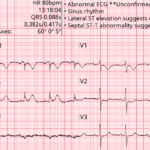
Baltimore City EMS ECGs: Pitfalls and Mimics (Part 1)
A 68-year-old man is brought to the emergency department by EMS with acute chest discomfort. The following prehospital ECG was obtained and shows concave ST elevation across multiple leads. The…
Bidirectional Ventricular Tachycardia (BiVT)
Key Points: BiVT is a regular wide-complex tachycardia with strict beat-to-beat alternation of QRS axis and/or bundle-branch pattern (often an approximately 180° frontal-plane axis flip). In adults, assume digoxin toxicity…
Atrial Parasystole
Key Points: Atrial parasystole is a rare atrial rhythm in which an ectopic atrial focus fires at its own intrinsic rate, relatively protected from sinus-node reset by entrance block. The…
T Wave Alternans
Key Points: Definition: Beat-to-beat alternation in T wave amplitude or morphology with stable P waves and QRS complexes. Significance: A visible marker of ventricular electrical instability. Strongly associated with torsades,…
Ventricular Tachycardia (VT): Core Overview
Key Points VT is a ventricular-origin rhythm: ≥3 consecutive ventricular beats, QRS >120 ms, rate usually 120–250 bpm. Types include monomorphic VT, polymorphic VT, torsades (PMVT with long QT), ventricular…
Ventricular Tachycardia (VT) Mimics
Key Points: Initial Assumption: Any wide (QRS >120 ms), regular tachycardia should be considered ventricular tachycardia (VT) until clearly proven otherwise. VT Characteristics: VT generally has a ventricular rate of…
Pulseless Ventricular Tachycardia (pVT) Arrest
Key Points: Defibrillation First, Minimal Pauses: pVT is rapidly fatal without immediate shocks and high‑quality CPR. Charge defibrillator during compressions and resume compressions immediately after each shock. pVT is a…
Atrial Fibrillation (AFib)
Key Points Prevalence: The most common sustained cardiac arrhythmia, particularly prevalent among elderly individuals, associated with increased stroke, heart failure, and mortality risks. Mechanism: Caused by chaotic, multiple reentry circuits…
Electrical Storm
Key Points: Definition: Electrical storm is defined as three or more episodes of sustained ventricular tachycardia (VT), ventricular fibrillation (VF), or appropriate implantable cardioverter-defibrillator (ICD) shocks within 24 hours. Some…
Ventricular Fibrillation (VF) Arrest
Key Points: Defibrillation First, Minimal Pauses: VF is rapidly fatal without immediate shocks and high‑quality CPR. Charge during compressions and resume compressions immediately after each shock. Chaotic Electrical Activity: VF…
Ventricular Flutter (V-Flutter)
Key Points: Definition: A malignant ventricular tachyarrhythmia with a regular, sine-wave–like waveform at ~250–350 bpm, no isoelectric baseline, and no discernible P/QRS/T distinction. Clinical importance: Rapidly degenerates into ventricular fibrillation…
Unstable Bradyarrhythmias
Key Points: Unstable bradyarrhythmias cause poor perfusion which can rapidly progress to shock, irreversible organ injury, or cardiac arrest. Priority: Do not treat the heart rate alone — treat clinical…
ECG Tags
- A-Z
- ACS Mimics
- ACS-OMI
- Activation
- Advanced Level Curriculum
- Annual ECG Competition
- Anterior OMI
- Anterior STEMI
- Approach
- Arrest
- Arrhythmia
- Arrhythmogenic Cardiomyopathy
- Artifact
- ARVC
- ARVD
- Atrial Parasystole
- Attending
- AV Block
- aVF
- aVL
- aVR
- Axis
- Basics
- Board Review
- Bradyarrhythmia
- Chest Pain
- Clumped Beats
- Conduction
- Core
- Core Level Curriculum
- Critical ECG Patterns
- Curriculum
- DDx
- Delta
- Devices
- Diagonal Branch Occlusion
- Differential Diagnoses
- Diffuse ST Elevation
- Documentation
- Early Repolarization
- ECG Interpretation
- ECG Localization
- ECG Variant
- Education/Teaching
- Electrolytes
- Emergencies
- Emergent Cath Lab Activation
- EMS
- Expert Level Curriculum
- Foundations Level Curriculum
- Guidelines
- High-Lateral STEMI
- Hub
- Hyperacute T waves
- Hypercalcemia
- Hyperkalemia
- Hypermagnesemia
- Hypocalcemia
- Hypokalemia
- Hypomagnesemia
- Hyponatremia
- Hypothermia
- I
- II
- Index
- Inferior OMI
- Inferior STEMI
- Intervals
- Irregular
- Ischemia
- Ischemia & Infarction
- J Waves
- JT
- Juvenile T wave
- LAD Occlusion
- Lateral STEMI
- LBBB
- LCx Occlusion
- Lead Placement
- Life Savers
- LV an
- LV Aneurysm
- Mastery Level Curriculum
- Metabolic
- Mimics
- Morphology
- Narrow QRS
- Occlusion MI
- OMI Pattern
- Orthodromic AVRT
- Osborn Waves
- P Wave
- Paced Rhythms
- Pacemaker/ICD
- Paramedics
- Pauses
- PE
- Pediatrics
- Pericardial
- Pericarditis
- PGY-1
- PGY-2
- PGY-3
- PGY-4
- Post-Cardiac Arrest
- Posterior Extension
- Posterior MI
- Posterior STEMI
- PR
- Preexcitation
- Premature Complexes
- Prolonged QT
- Pulmonary Embolism
- Pulse-Tapping Artifact
- PVCs
- Q Wave
- QRS
- QT
- R Waves
- RAD
- Rate
- RBBB
- RCA Occlusion
- Regular
- Reperfusion
- Rhythm
- RR
- S Waves
- Segments
- Seizure
- Serial ECGs
- Sgarbossa
- Shock
- South African Flag Sign
- ST
- ST Depression
- ST Elevation
- STEMI
- STEMI Equivalent
- STEMI Mimics
- STEMI Negative OMI
- Stepwise
- Stroke
- Structural
- Students
- SVT
- Syncope
- T Wave Inversion
- T Waves
- Tachyarrhythmia
- Tachycardia
- Tamponade
- Terminal QRS Distortion
- Toxicology
- TP
- Traditional STEMI Criteria
- U Waves
- Unstable
- V1-V4
- V2
- V5
- V6
- Vectors
- Ventricular Repolarization
- Ventricular Rhythms
- Ventricular Tachycardia
- Voltage
- Waveforms
- Wide QRS
- Workflow
- WPW
© 2026 ECG Weekly. All rights reserved. | Terms of Use | Privacy Policy
Powered by the member(dev) platform
 Loading...